







What Usually Makes Conventional Boat Ownership Difficult?
A boat can be simple once it is on the water. The complication often comes from everything surrounding it.
A conventional trailerable boat needs a tow vehicle, trailer, suitable storage, and access to a launch ramp. On a busy weekend, launching can involve reversing a trailer, separating the boat from the tow vehicle, finding trailer parking, and repeating the process when it is time to leave.
Marina storage solves some of those problems but creates another ownership model, with a slip or storage arrangement that has to be maintained whether the boat is being used or not.
That is the friction WaterCar is designed to remove. The Compendium frames the problem around a simple observation: many boat owners do not use their boats as often as they would like because the effort required to get on the water competes with limited free time.
An amphibious boat with wheels changes the sequence.
Instead of:
Garage → tow vehicle → trailer → ramp → launch → trailer parking
The WaterCar can follow:
Garage → road → ramp or beach → water
When the outing is finished, the process works in reverse.
How Does an Amphibious Boat Make Launching Easier?
The biggest advantage of an amphibious boat is not necessarily speed. It is access.
The WaterCar integrates its road system directly into the vehicle, allowing the owner to drive to the water rather than transporting a separate boat and trailer and then launching the boat from that trailer.
Its LaunchMode system is designed around a single-button transition. When entering the water, the front wheels retract hydraulically, the outboard moves into operating position, and the ProDrive™ land system disengages. The reverse sequence returns the vehicle to road mode.
That means the transition itself is not supposed to be a multi-stage mechanical procedure for the owner.
Can One Person Launch an Amphibious Boat?
The WaterCar concept is designed to make launching possible without the traditional trailer choreography.
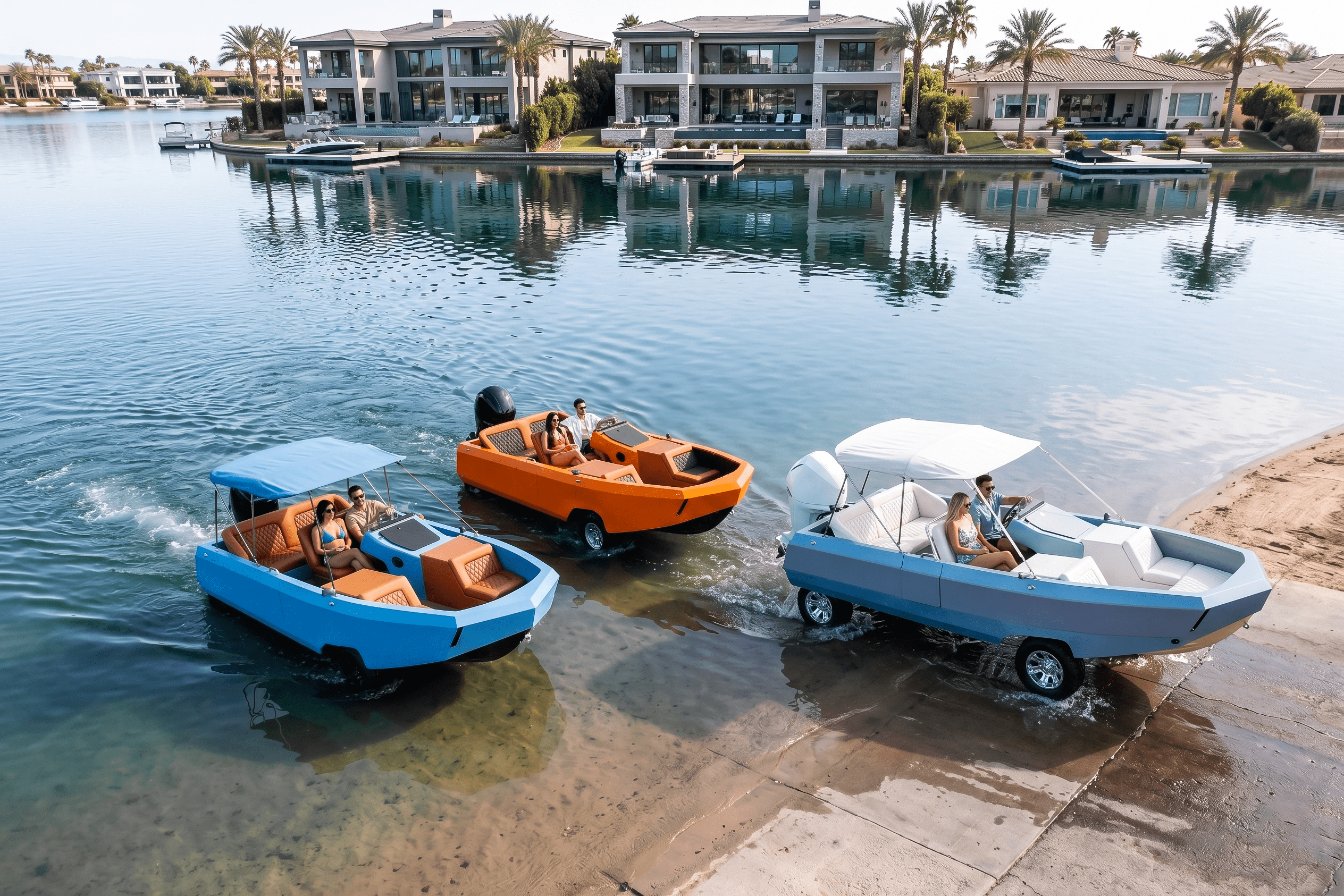
A driver can approach the ramp, enter the water, activate the transition system, and continue under marine propulsion. Retrieval works in the opposite direction: drive out of the water, transition back to road mode, and leave.
That is a major difference from conventional trailer boating because there is no requirement to detach the boat from the trailer, move the tow vehicle away, locate trailer parking, and later reconnect everything.
It does not mean that boating becomes a one-person activity in every situation. Local ramp conditions, weather, water traffic, passenger safety, and the operator’s boating experience still matter. The convenience comes from removing the logistics, not from eliminating the need for good judgment.
How Does WaterCar Transition From Land to Water?
WaterCar’s transition is handled by LaunchMode.
At the ramp, the vehicle enters the water under its road system. Once positioned for launch, a cockpit button initiates the transition:
- The front wheels retract hydraulically.
- The outboard moves into operating position.
- ProDrive™ disengages.
- Marine propulsion takes over.
The hydraulic system uses custom 316 stainless-steel double-acting cylinders and a Mercury OEM hydraulic pump. The system was designed specifically for repeated immersion rather than adapting ordinary automotive components to a marine environment.
The important point is that the owner does not have to manually transform the vehicle component by component.
Can an Amphibious Boat Launch Without a Boat Ramp?
Yes, where local conditions and regulations permit it.
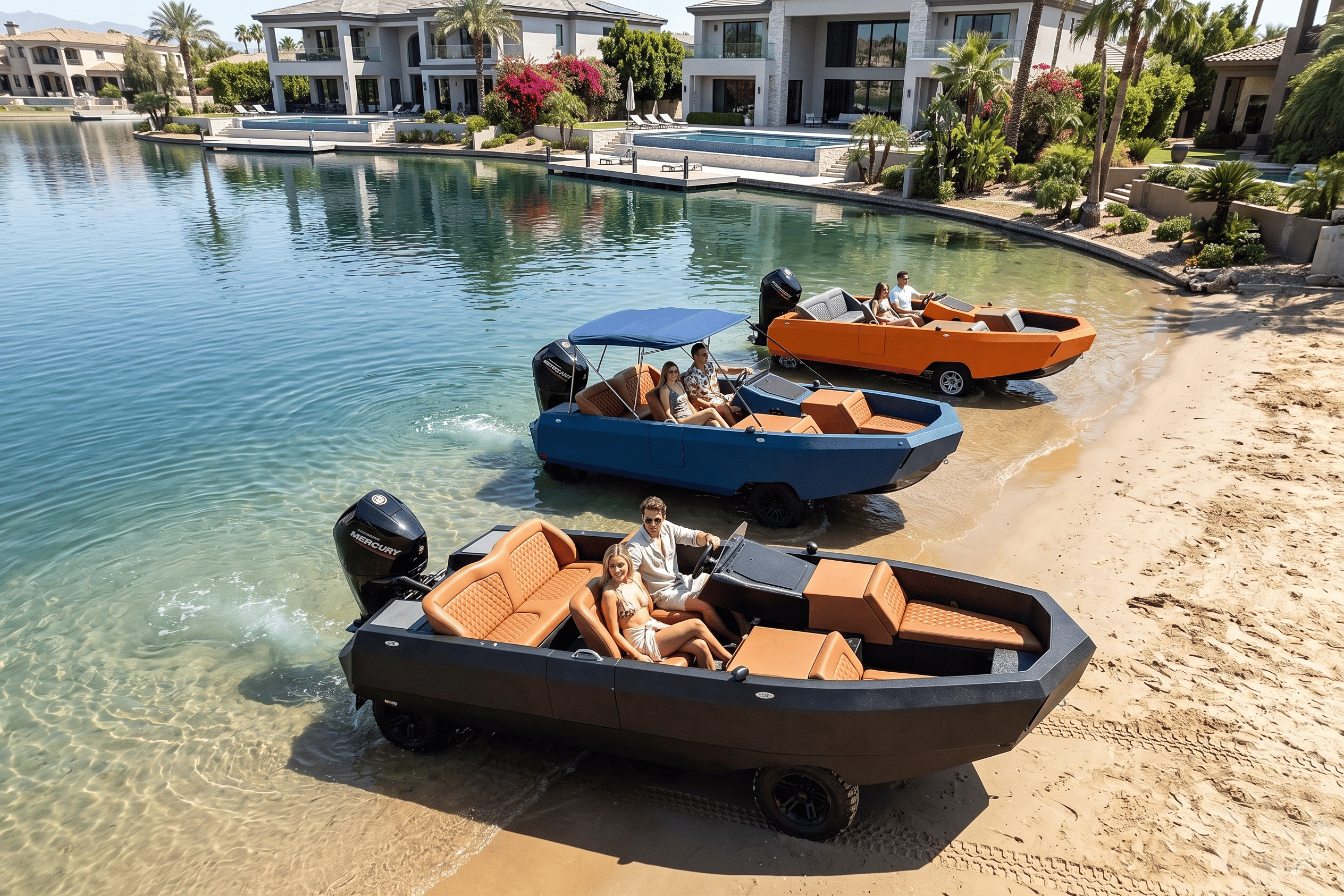
One of the advantages of an amphibious boat with wheels is that it does not depend exclusively on a traditional concrete launch ramp. The Compendium describes the WaterCar being driven directly from a beach as well as launched at a standard boat ramp.
However, “can” does not mean “should be launched anywhere.” Shoreline access, tides, water depth, terrain, environmental restrictions, and local regulations all need to be considered before using a beach or other alternative entry point.
The engineering makes alternative access possible. The owner still needs to choose the right location.
Is an Amphibious Boat Difficult to Drive?
This is where the answer needs some nuance.
The WaterCar is designed to make accessing the water easier. It is not designed to make boating experience irrelevant.
The Compendium specifically positions the WaterCar toward experienced boaters. With a 115-hp outboard and a genuine performance hull, it is not intended to be a substitute for learning basic boating skills.
What Does It Feel Like to Operate on Land?
On land, the WaterCar is designed to behave like a low-speed vehicle rather than a conventional highway automobile.
Its ProDrive™ system uses a sealed permanent-magnet electric motor, waterproof Curtis controller, and limited-slip differential. The road drive is governed to 25 mph under FMVSS 500, with a stated road range of approximately 20 miles.
That is intentional.
The road system does not exist to turn the WaterCar into a long-distance highway cruiser. Its job is to handle the boat’s logistics: leaving the garage, reaching the water, moving around a waterfront property, and returning home.
The result is a quieter, simpler road-driving experience suited to short trips.
What Does It Feel Like to Operate on Water?
On water, the WaterCar becomes a genuine boat.
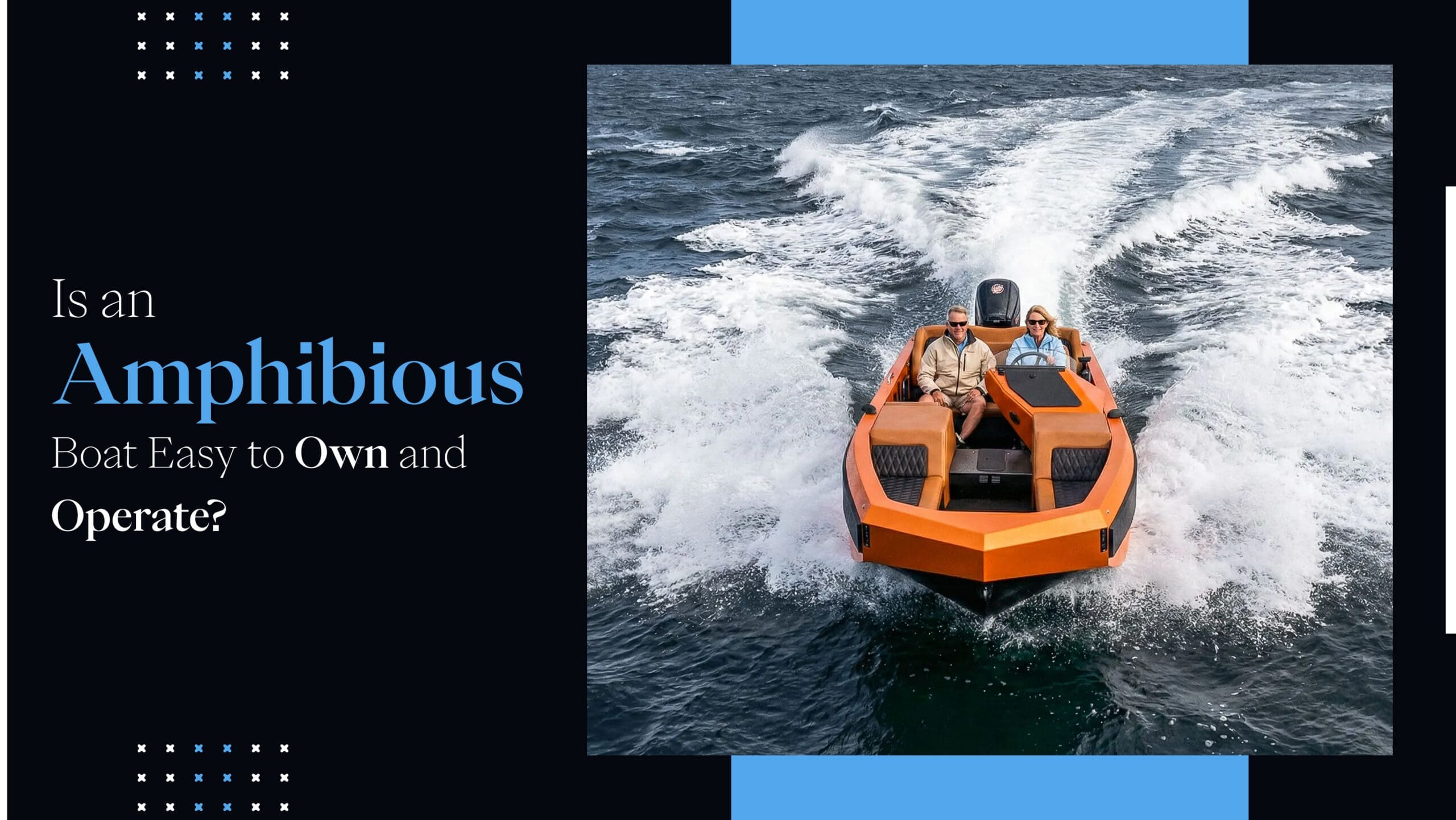
The current specification uses a Mercury Pro XS 115 HP four-stroke with a custom four-blade stainless-steel propeller. Standard marine performance is rated at up to 35 mph, with an 80-mile range from an 18-gallon tank and capacity for four people or 850 pounds under the stated USCG rating.
The hull is designed around conventional marine principles rather than simply floating a road vehicle. Its trihull V-bottom, reverse chines, lifting strakes, and carefully controlled hull geometry are intended to help it get onto plane, maintain stability, and handle changing water conditions.
So operating it on water still feels like operating a serious boat. The amphibious capability changes how you reach the water, not the fundamentals of being a responsible boat operator.
Does the Operator Have to Learn Two Steering Systems?
No.
One of WaterCar’s notable design choices is a single steering system rather than separate road and marine steering controls.
The steering system remains connected in both environments, with the road wheels and outboard working together. This also allows the vehicle to maneuver in shallow water under outboard power while retaining wheel steering.
That removes one of the common usability problems associated with amphibious vehicles: having to mentally switch between completely different control systems.
What Does a Typical WaterCar Outing Look Like?
Imagine leaving home on a Saturday morning.
You do not need to hook up a boat trailer. You do not need to find a storage yard and retrieve the boat. You simply get into the WaterCar and drive toward the water.
At the launch point, you enter the water and activate LaunchMode™. The wheels retract, the outboard takes over, and you are boating.
After spending the day on the water, you reverse the process. Drive out, transition back to road mode, and head home.
That simplicity matters most when you want to use the boat more than once in a day.
The Compendium points out that a conventional trailer can make even a second outing feel like a production because launching and retrieving have to happen again. With WaterCar, an owner can return home for lunch and go back out later without repeating the entire trailer process.
That is the real difference in amphibious boat ownership: fewer steps between deciding to go boating and actually being on the water.
Does an Amphibious Boat Require More Maintenance?
It might seem that a vehicle designed for two environments would automatically require twice the maintenance.
WaterCar’s approach is to make the opposite possible by using familiar, serviceable components wherever practical.
The Compendium describes the vehicle as deliberately built around parts from established automotive, marine, and off-road suppliers rather than relying on proprietary components that only the manufacturer can diagnose or replace.
That does not mean maintenance disappears. It means the maintenance is intended to remain understandable.
Which Systems Still Need Routine Maintenance?
An amphibious boat still has all the normal responsibilities of a serious boat and vehicle.
Depending on the system and use, an owner needs to pay attention to:
- Outboard servicing
- Hydraulic system inspection
- Brakes and suspension
- Tires and wheels
- Battery condition and charging
- Marine electrical systems
- Bilge pumps
- Navigation equipment
- Fuel system
- Hull and hardware condition
- Corrosion protection
The key difference is that these systems are not treated as mysterious amphibious-vehicle-only technology.
WaterCar uses components from manufacturers including Mercury, Wilwood, Simrad, Victron Energy, Eibach, Timken, Unisteer, Curtis, Blue Sea Systems, and Rule. The stated objective is to make service possible through established marine and automotive networks.
How Is WaterCar Designed for Freshwater and Saltwater?
WaterCar uses a single specification built around saltwater-capable materials rather than creating a completely separate freshwater and saltwater version.
The Compendium specifically identifies marine-grade aluminum, 316 stainless hardware, and other corrosion-conscious materials throughout the vehicle. The principle is straightforward: materials capable of handling saltwater also provide a strong foundation for freshwater use.
That does not remove the need for proper cleaning and routine marine maintenance after use. Saltwater remains a demanding environment for any marine machine.
What it does provide is an amphibious boat engineered from the beginning with marine corrosion in mind.
Is an Amphibious Boat Difficult to Repair?
This is one area where the design philosophy matters considerably.
A highly specialized machine can become difficult to own if every failure requires a trip back to the manufacturer.
WaterCar was deliberately designed around the opposite principle.
Why Are Proprietary Parts a Concern?
A proprietary component can create a frustrating ownership chain:
Failure → diagnosis → manufacturer → special part → shipping → repair
That can turn a relatively simple problem into a major interruption.
The Compendium says one of WaterCar’s founding goals was to avoid this model. The vehicle uses established components and standard mounting approaches so that marine mechanics, automotive technicians, and other qualified professionals can understand and service the systems.
The approach extends beyond repair to replacement. The document states that major components such as the outboard, battery, and drive motor are designed to be replaceable, with standard mounting patterns where possible.
Who Can Service a WaterCar?
The intended answer is: the same types of qualified professionals who already service the systems used on it.
A Mercury dealer or marine mechanic can service the outboard. Automotive technicians can work with many of the road systems. Marine electricians can work with the marine electrical architecture.
That is particularly important for long-term amphibious boat maintenance because owners are not expected to depend entirely on a single factory location.
How Do You Charge and Fuel an Amphibious Boat?
WaterCar separates road and marine propulsion.
The road system uses a sealed 48-volt LiFePO4 battery, while the water system uses the Mercury gasoline outboard.
The battery can be charged from a standard household outlet. The Compendium specifies approximately 6–8 hours of charging and a smart charger capable of automatically detecting 110V–250V input for international owners.
The gasoline engine is reserved for the environment where its power is most useful: the water.
That division also simplifies the ownership experience. The electric road drive does not need its own gasoline engine, exhaust system, radiator, and associated maintenance simply to travel the short distance between home and the water.
Do You Need a Trailer or Marina Slip?
Not necessarily.
This is one of the biggest differences between WaterCar and a conventional trailerable boat.
The vehicle integrates its own wheels and road drivetrain, so a conventional boat trailer is not required for ordinary local use.
For longer journeys, TowLink allows the WaterCar to be towed behind a properly rated truck, SUV, or RV using a standard 2-inch hitch receiver. The WaterCar rides on its own rear wheels rather than requiring a separate boat trailer.
That means there is no separate trailer to purchase, register, store, or maintain.
The same principle applies to storage. Rather than requiring a marina slip or off-site boat storage, the WaterCar can be parked at a suitable home location like a road vehicle, subject to local rules and property requirements.
The garage effectively becomes part of the boating setup.
What Registration, Licensing and Insurance Are Required?
This is one area where the answer depends on where you live.
In the United States, the WaterCar Compendium states that the vehicle is designed to qualify as both a motor vehicle and a watercraft. It carries a 17-digit NHTSA-registered VIN for road registration and a Coast Guard Hull Identification Number for vessel registration.
The current WaterCar is also described as complying with US Coast Guard and NMMA/ABYC requirements and with FMVSS 500 for the federal Low Speed Vehicle class. The Compendium states that it is street legal on roads that permit Low Speed Vehicles.
That is an important distinction from simply calling any amphibious boat a street-legal amphibious boat.
Registration, road access, licensing, insurance, inspections, and equipment requirements can vary by state, country, and road classification. Buyers outside the United States should confirm the applicable requirements before purchase.
In other words, the vehicle is engineered to fit established regulatory systems; the owner still has to complete the registration process applicable to their jurisdiction.
What Safety Checks Should an Owner Complete Before Every Trip?
The Compendium lists a full set of marine safety equipment, including LED navigation lights, stern lighting, stainless cleats, dual bilge pumps, two USCG-approved fire extinguishers, four life jackets, and a Type IV throwable cushion.
The document does not prescribe a single universal pre-trip checklist, but an owner should logically verify the condition and readiness of these systems before departure.
A practical pre-trip check should include:
- Confirm required life jackets and throwable equipment are aboard and accessible.
- Check navigation and stern lights.
- Verify bilge pumps are operational.
- Check fuel level and inspect for obvious fuel-system issues.
- Confirm the battery has adequate charge for the planned road operation.
- Inspect tires, wheels, and visible suspension components.
- Check the outboard and steering system.
- Confirm the transition system is functioning correctly before entering the water.
- Review weather, water conditions, and the intended route.
- Confirm the vehicle is within its passenger and load limits.
The principle is the same as with any capable boat: good engineering reduces unnecessary complexity, but it does not replace responsible preparation.
What Are the Limitations of Owning and Operating an Amphibious Boat?
The biggest mistake would be assuming that an amphibious boat makes every aspect of boating effortless.
It does not.
The WaterCar removes much of the logistical friction around boating. It does not remove weather, water conditions, navigation, docking judgment, passenger safety, or the need to understand the vessel.
There are also practical limits to the road system. The current WaterCar is limited to 25 mph on land and is designed primarily to move between home and the water rather than function as a conventional long-distance automobile.
Its marine capacity is also defined. The current Watercar specification is rated for four people or 850 pounds, so buyers need to consider their typical passenger and gear requirements.
And while the ability to launch from alternative locations is a major advantage, not every beach or shoreline is suitable or legally accessible.
Finally, the WaterCar is not positioned as a beginner’s boat. The Compendium describes it as a serious boat intended for experienced boaters.
So the simplest way to describe its limitations is this:
It simplifies boat ownership. It does not eliminate the responsibilities of boating.
Who Is an Amphibious Boat Best Suited For?
An amphibious boat makes the most sense for someone who already understands why conventional boat ownership can be frustrating.
It is particularly suited to boaters who:
- Want to spend more time on the water and less time launching.
- Live close enough to the water to make road access useful.
- Want to avoid maintaining a conventional boat trailer.
- Have suitable home parking or garage space.
- Move between multiple waterfront locations.
- Want the freedom to launch without depending exclusively on a conventional ramp.
- Value familiar, serviceable automotive and marine components.
- Want a serious boat without committing to permanent marina storage.
It is less about replacing the traditional boating experience and more about removing the infrastructure that stands between the owner and that experience.
That is ultimately the answer to the question: is an amphibious boat easy to own and operate?
With the right design, it can be.
The important word is design.
WaterCar’s approach is to make the vehicle itself responsible for much of the logistics that normally surround a boat. ProDrive handles the road. LaunchMode handles the transition. The marine system handles the water. TowLink handles long-distance transport without requiring a conventional trailer. Standardized components help keep servicing within familiar marine and automotive networks.
The result is not a boat that asks the owner to learn a new category of machinery every time they want to go out.
It is a serious boat designed to be easier to reach, easier to store, and easier to bring home.
The garage becomes the marina. The ramp becomes optional. And the distance between deciding to go boating and actually being on the water becomes remarkably short.
If that is the kind of ownership experience you are looking for, explore the WaterCar range and discover what it means to own a boat that can drive home under its own power.