

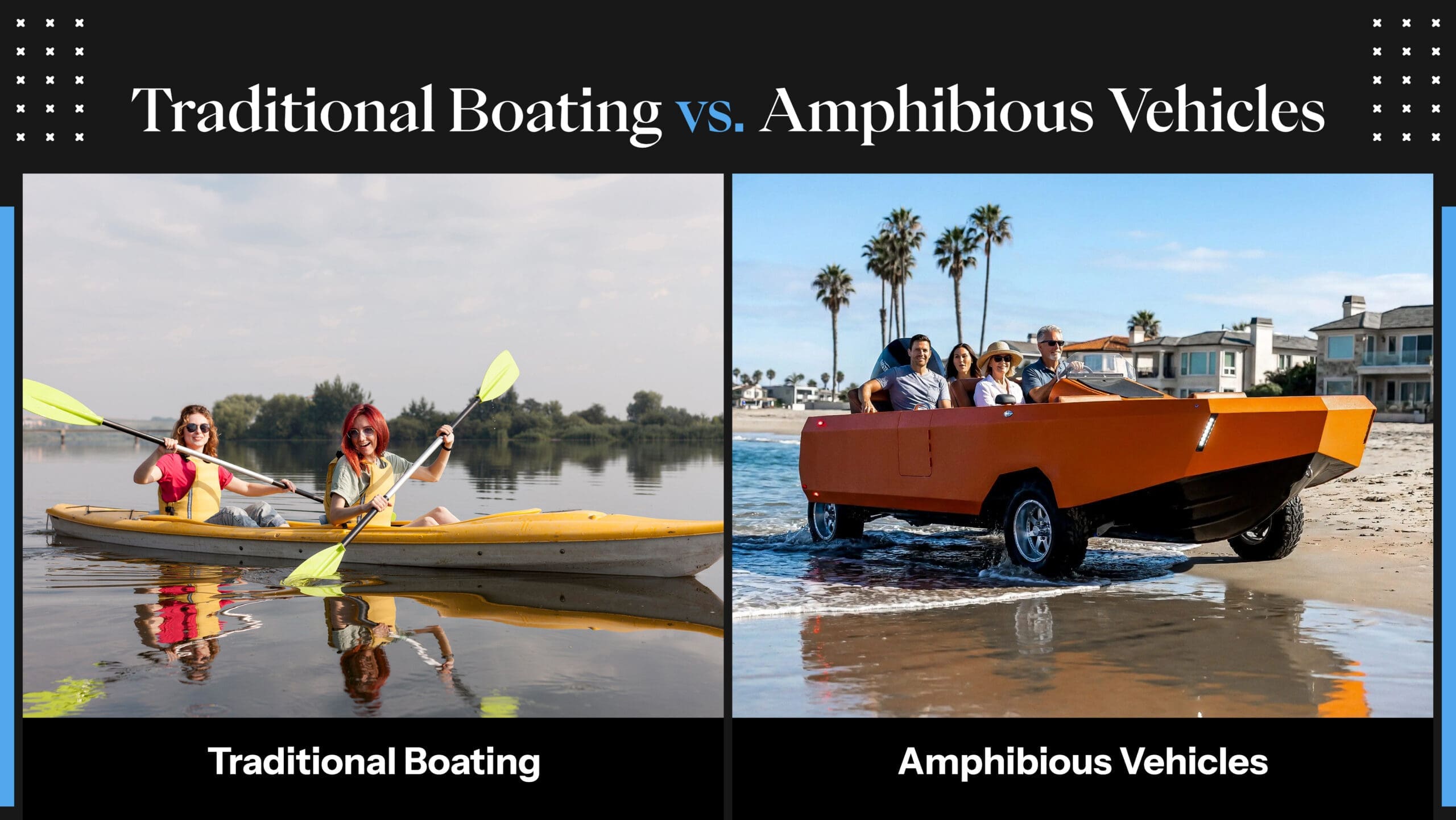


The amphibious vehicle is a new type of boat that promises to change the way we interact with water. These street-legal boats are no longer just in science fiction. They are becoming a popular choice because they combine the excitement of ocean exploration with the ease of land travel.
But how do they really compare to the long-standing tradition of boating?
This in-depth guide examines the traditional boating vs. amphibious vehicles debate, covering their main differences, how they are used in the real world, and the exciting future they promise, with a special focus on new technologies.
What Is Traditional Boating?
Traditional boating includes a wide range of craft, from fast kayaks and fishing skiffs to fancy yachts and powerful speedboats. A boat designed for water activities is at the heart of traditional boating. These boats usually need a special place to launch, return, store, and repair them.
Owners often buy trailers, marina slips, or dry storage facilities, each with its own costs and logistical issues. The experience is usually broken into five parts: driving to the water, launching the boat, enjoying the water, getting the boat back, and returning it to storage. This model has been popular with fans for hundreds of years, but it has built-in friction points that can make it less fun overall.
What Are Amphibious Vehicles?
Picture a vehicle that can easily switch from highway to waterway, making it hard to tell if it’s a car or a boat. That’s what an amphibious vehicle is all about. These clever machines are built to work perfectly on both land and water, making them incredibly useful. Amphibious vehicles are the only option for traveling across multiple environments.
Traditional boats can only go on water, and cars can only go on land. They have special propulsion systems, strong hulls, and wheels or tracks that can be retracted, allowing them to move over a wide range of terrain. The promise of an amphibious vehicle is not just that it can do two things at once. It also changes how easy it is to get around and how spontaneous it is, turning adventures that used to be split up into separate land and water trips into a single, flowing experience.
Traditional Boating vs. Amphibious Vehicles
When we look at amphibious vehicles, we need to compare them with regular boats on several key points. Each section below shows how these options differ.
Here’s the comparison organized into a table:
| Category | Traditional Boating | Amphibious Vehicles |
|---|---|---|
| Access | Needs a boat ramp, marina, or trailer; getting to the water can mean long drives and waits | Can drive straight from a garage into the water from almost any shoreline, no ramp or trailer needed |
| Launch & retrieval | Biggest hassle: hitching the trailer, navigating traffic, backing down the ramp, then reversing it all on return | Just drive in, switch to water mode, and go — no towing or ramp required |
| Performance focus | Built specifically for speed, stability, or a given water sport | Historically a trade-off between land and water performance, though newer EV models are narrowing that gap |
| Maintenance | Engine servicing, hull cleaning, anti-fouling, winterizing, plus separate trailer upkeep (tires, bearings, brakes) | Combines marine and automotive upkeep (e.g. outboard motor service plus the electric drive link); marine-grade materials help reduce the load |
| Ownership costs | Purchase price plus trailer fees, licensing, insurance, fuel, dock fees, winterizing, and repairs | Higher upfront cost, but no towing or slip/launch fees; shared parts across systems help offset dual-maintenance costs |
| Infrastructure dependence | Relies on marinas, ramps, and storage facilities, each with location-based costs | Less dependent on specialized facilities since the vehicle works on both land and water |
| Safety & emergencies | Standard safety gear; a mechanical failure at sea may require towing | Built for both environments (e.g. unsinkable hull meeting marine and road safety standards); can potentially drive out of trouble |
| Best use cases | Long-distance voyages, deep-sea fishing, dedicated water sports | Given its amphibious capabilities, it is ideal for people residing in lakes and coastal areas. |
| Limitations | Confined to water; cumbersome launch/retrieval; storage can be costly | Limited in rough terrain or harsh seas; capped land speed (e.g. 25 mph for LSVs); high upfront cost; dual-system upkeep |
Where Do Amphibious Vehicles Shine in Reality?
An amphibious vehicle shines when it can be used to reach places that otherwise could not be reached by conventional water transport. This is possible when:
- Coastal Living & Waterfront Access: For those who live on the coast or near lakes and rivers, with access to waterways, owning an amphibious car would completely change their lives. Gone are the days when they have to tow their boats behind their cars for miles through heavily trafficked roads, wait for the turn of traffic, and finally launch them. With their amphibious car, they could simply roll out of their driveway and onto the water without the hassle of launching their boat.
- Tourism & Adventure Experiences: For adventure tourists, amphibious vehicles can be used as part of tour packages that take visitors through different environments. The vehicle takes them from exploring distant, secluded islands to cruising along a beautiful river and then through a quaint coastal village. The amphibious vehicle can reach places neither regular boats nor cars can.
- Families and Recreational Boaters: A family will indeed encounter many issues getting the boat to the water when kids and other equipment are involved. An amphibious car makes things a lot easier on that front. There is no need to worry about trailers, parking issues, or busy boat ramps. This makes spending time at the water much simpler and therefore more fun for everyone.
- Superyacht Owners and Yacht Tenders: Space and ease of access are essential for superyacht owners. Regularly used tenders are equipped with davits or tender garages, and their deployment is often a multistep procedure. The amphibious car, like WaterCar EV, represents the perfect solution for the luxury yacht tender. Such a vehicle can be parked either on board the yacht or in a tender garage, and then transferred directly from the yacht to the water, or vice versa – from the water to the beach or docks.
- Private Island Owners: The possession of private islands also presents unique challenges regarding transport to and from the island. The amphibious car is the best answer to that problem. Owners of private islands can drive their amphibious cars from their island through the water and onto roads to run errands or other tasks, saving time and effort by avoiding the need for multiple cars.
When Traditional Boats Are the Better Choice
Although there are many advantages to amphibious boats, traditional boating will still maintain its own significance when it comes to certain needs or choices:
- Highly Specialized Performance: In activities that require specialized hulls, such as competitive sailing, deep-sea fishing, and offshore racing, a traditional boat will likely offer better performance than an amphibious one.
- Long Distance Offshore Trips: Although amphibious vehicles can work great within coastal waters and even rivers, a trip that will take you across seas and oceans is best suited for a traditional yacht.
- Limited Budget: An old traditional boat can serve as a way to get into recreational boating despite the costs, particularly for people on a budget.
- Large Passenger/Load Capacity: If you are looking for passenger or load capacity, a larger traditional boat might be a better fit.
Why the Future of Water Mobility is Headed for Amphibious Cars
Indeed, there is a paradigm shift in the trend that governs the future of water mobility. In line with the growth of cities in coastal areas and the increase in environmental awareness, the need for a solution that is flexible and less dependent on infrastructure development will become increasingly common. Some of the reasons why amphibious vehicles will be the vehicle of choice in the future include:
- Environmental Considerations: With the emergence of electric and hybrid models, the future of environmentally friendly amphibious vehicles seems bright and promising, especially for leisurely water travel.
- Urbanization Trends: The increasing interest in waterfront property will make it desirable to have a means of accessing water without first dealing with crowded marinas.
- Technological Evolution: There has been a steady improvement in materials science, propulsion technology, and automation in amphibious cars, meaning that old limitations will soon no longer apply.
- Lifestyle Integration: Today’s consumer desires efficiency and experiences that seamlessly integrate into their daily life routines. The use of amphibious vehicles brings an entirely new level of spontaneity and freedom, offering an experience that lacks the separate segments of conventional transportation.
- Better Economic Equation Long-Term: Although amphibious vehicles require an initial financial outlay, the economic equation for the future favors them. The cost of using regular vessels will keep rising due to rising marina fees, higher fuel prices, and increased maintenance costs. In turn, amphibious vehicles avoid many recurring expenses, including the need to purchase a trailer or store the vessel. The economic model becomes much easier to predict.
- Growing Use Case Variety: Nowadays, amphibious vehicles are no longer reserved for luxury or entertainment. Their applications can now be seen in sectors as diverse as emergency services, environmental research and observation, coastal security and inspection, among others. The same technology can be used in various scenarios, from recreational trips to mission-critical tasks.
- Mindset of Consumers: Psychological factors may be considered another key driver, and consumers are now more inclined than ever before to ask questions about legacy systems that unnecessarily complicate their lives. As ridesharing technology made conventional means of transportation obsolete and streaming technology made DVDs and tapes obsolete, amphibious vehicles are challenging the separation between land and boat travel.
- Advantage over Conventional Boats: Infrastructure independence is also a significant benefit. In crowded areas, it is increasingly difficult to launch boats using existing infrastructure, which is another factor driving the popularity of amphibious vehicles. They offer inherent infrastructure independence that is hard to match in any other boat or vehicle.
All of these factors clearly indicate a trend towards the adoption of amphibious vehicles.
Choosing Between Traditional Boating vs Amphibious Vehicles
The debate between traditional boating and amphibious vehicles is not about declaring a universal winner. Instead, it is about understanding priorities, lifestyle needs, and how individuals prefer to experience water.
The traditional boating experience is steeped in heritage, craft, and performance. To those who require accuracy, scale, and dedicated marine functionality, traditional boats will always have an allure. There is something about the tradition of boating that still appeals in its authentic and deep-rooted way.
But amphibious cars signify a completely new attitude towards boats – an attitude where efficiency and adaptability reign supreme. They are certainly not attempting to dominate the world of boating, but they are looking to redefine the existing use of water resources.
For many modern users, the choice ultimately comes down to time.
If boating feels like an event that requires planning, coordination, and effort, traditional systems may start to feel limiting. On the other hand, if the goal is to make water a seamless part of daily life, amphibious vehicles offer a compelling alternative.
To sum up:
- Opt for conventional boats if you seek specialization and size.
- Opt for amphibious vehicles if you value mobility and flexibility.
As innovation advances and consumer needs change, the distinction between these two realms is sure to fade. The key is to continue enjoying water while being efficient and effective.