





How Do Amphibious Boats Get on Plane?
An amphibious boat gets on plane when its hull accelerates enough to generate dynamic lift and begin riding higher on the water. During this process, the wetted surface varies, hydrodynamic resistance is handled differently, and the boat settles into a faster running attitude.
For a conventional planing boat, that transition is already a carefully engineered balance of hull shape, power, weight, and trim. An amphibious boat has another challenge: it must carry the systems that allow it to operate on land without compromising its performance on water.
That makes the path from displacement mode to stable planing especially important when evaluating an amphibious vehicle.
What Does It Mean for an Amphibious Boat to Get on Plane?
At low speed, an amphibious boat operates primarily in displacement mode. The hull sits relatively deep in the water and moves forward by displacing water around it. Buoyancy supports most of the boat’s weight, while the hull experiences increasing water resistance as speed builds.
A planing boat operates differently.
As speed increases, water flowing beneath the hull produces increasing pressure. This pressure force then generates a dynamic lift, causing the hull to ride higher and be partially supported by the water through these hydrodynamic forces, instead of almost fully buoyant forces.
The result is a noticeable change in how the boat moves:
- The bow initially rises.
- The stern settles under acceleration.
- The hull climbs through the water.
- The wetted surface begins to decrease.
- The boat moves through the resistance hump.
- The running attitude becomes more stable.
- The hull settles onto its intended planing surfaces.
This is what boaters mean when they say the boat has gotten on plane.
How Does a Boat Move From Displacement to Hydrodynamic Lift?
The transition happens over a range of speeds rather than at one universal point.
As the driver adds throttle, the outboard generates more thrust and the hull accelerates. At first, the boat remains firmly in displacement mode. Then the increasing water flow beneath the hull begins to generate meaningful dynamic lift.
The boat may experience noticeable bow rise during this stage. At the same time, the stern can experience stern squat as the hull responds to propulsion and changing hydrodynamic forces.
As speed continues to build, the balance shifts.
Dynamic lift becomes more pronounced. The hull begins to come up, lifting the planing surfaces out of the water. The boat passes through the high-resistance portion of acceleration and begins to establish a more efficient running attitude.
Once the hull reaches stable planing, the boat is riding on a smaller, carefully controlled portion of its bottom rather than pushing its entire immersed hull through the water.
Why Is Reaching Plane Harder for an Amphibious Boat?
An amphibious vehicle has to achieve this transition while carrying equipment that a conventional boat does not.
That can include road wheels, suspension components, steering hardware, and other systems required for land operation. Those systems add weight and, if exposed to the water, can create additional resistance.
This is why amphibious design is more than adding wheels to a boat.
The vehicle needs to manage:
- Weight: More mass requires more lift and propulsion.
- Water resistance: Exposed road hardware can interfere with clean water flow.
- Weight distribution: The location of mass affects bow rise, stern squat, and running attitude.
- Hull geometry: The bottom must generate and control lift efficiently.
- Propulsion: The engine and propeller must provide enough thrust to reach planing speed.
The objective is to make the marine systems work as an integrated package, rather than asking a conventional boat hull to compensate for road-going hardware.
Which Hull Features Help an Amphibious Boat Generate Lift?
The hull is where planing performance begins.
The shapes of its hull affect how it interacts with water, where the pressure is applied under it, and how the water separates from running surfaces as its speed increases.
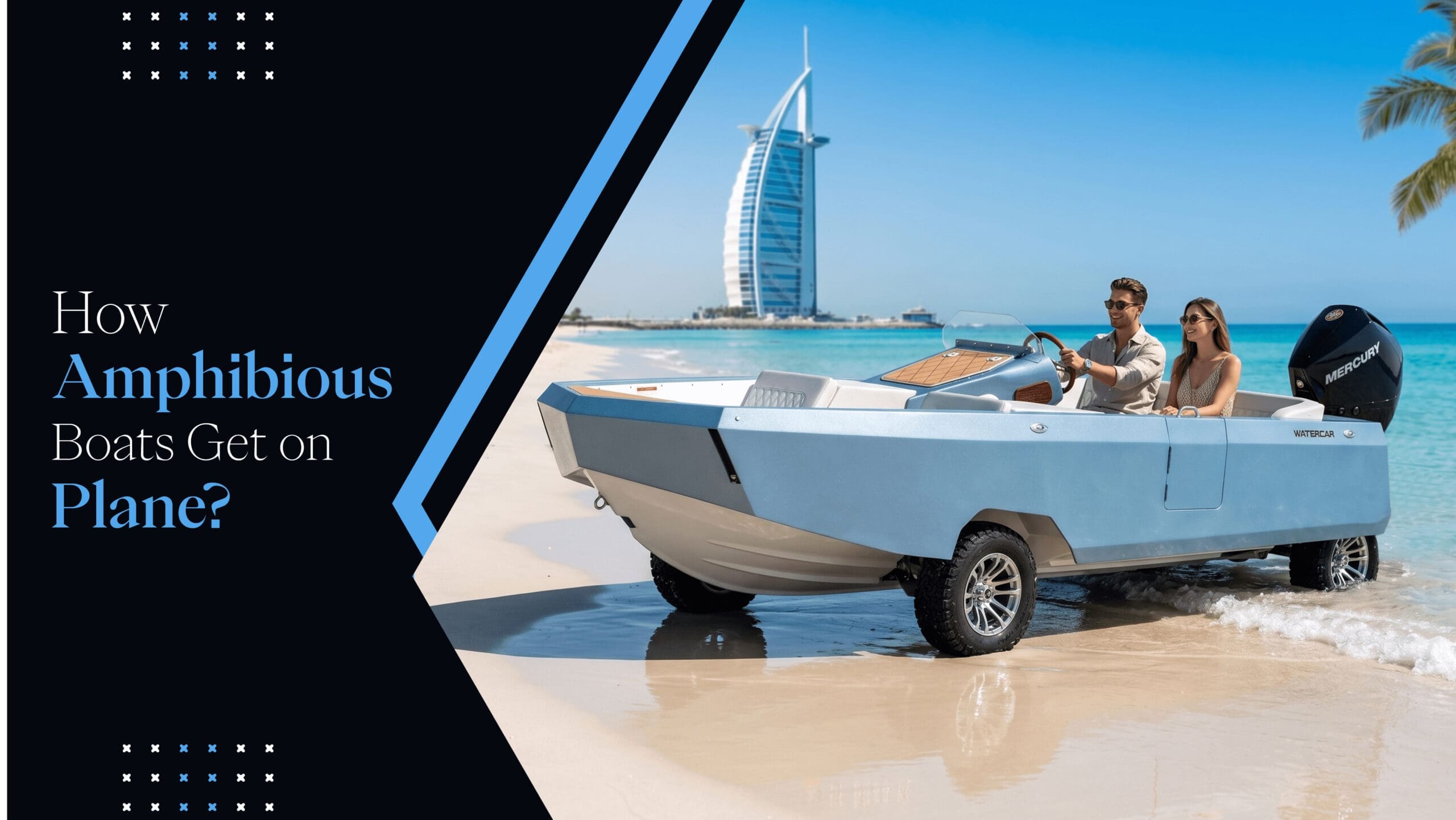
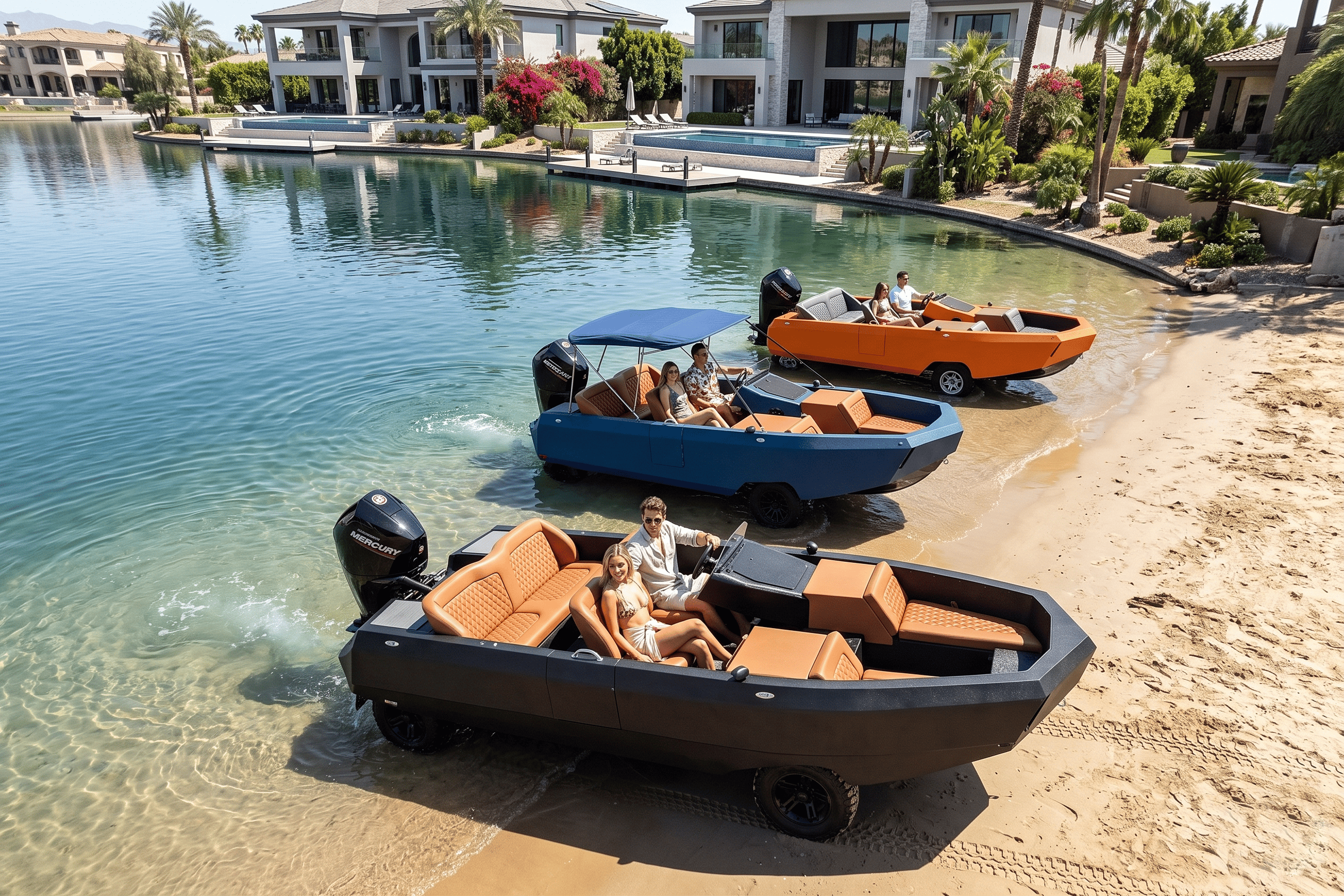
WaterCar’s EV uses a 19-foot welded aluminum unibody hull with a tri-hull V-bottom and reverse chines.
WaterCar says this hull design helps the vehicle plane quickly, hold a solid trim angle, and handle wakes and chop.
That combination of geometry is particularly important for an amphibious vehicle because the hull has to deliver genuine boat performance while accommodating the systems needed for road travel.
How Do the V-Bottom, Sponsons and Deadrise Control the Ride?
A V-bottom hull uses angled bottom surfaces rather than presenting one broad, flat surface to the water. The angle of those surfaces is described by deadrise.
Deadrise influences how the hull interacts with the water, particularly as speed and wave conditions change. But deadrise does not work alone. Its effect depends on the hull’s overall geometry, width, weight and intended operating range.
A trihull design adds additional running surfaces to that equation. The central section and outer sponsons interact with the water as the boat accelerates, influencing lift, stability and the amount of hull that remains wetted.
The important point is precision.
The hull needs to generate enough lift to rise efficiently while maintaining a controlled and predictable ride. Too much wetted surface creates unnecessary resistance; too little stability or poor weight distribution can compromise handling.
WaterCar describes its hull specifically as a tri-hull V-bottom with reverse chines and precision-oriented construction, rather than treating one isolated hull feature as the answer to planing performance.
How Do Reverse Chines and Lifting Strakes Help the Hull Rise?
Water flowing beneath a planing hull needs to be managed carefully.
Reverse chines influence how water leaves the sides of the hull. They can help redirect water outward and contribute to the hull’s stability and spray control as speed increases.
Lifting strakes, where used as part of a planing hull’s geometry, can create additional hydrodynamic lift and influence the way water flows beneath the running surface.
Neither feature works in isolation.
The effective planing surface is the result of multiple elements working together:
Deadrise + chines + strakes + sponsons + hull width + weight distribution.
For an amphibious boat, there is another consideration: road hardware has to be positioned so that it does not interfere with these intended water-flow paths.
That is why the relationship between the hull and the retractable running gear matters just as much as the individual hull features.
How Do the Center of Gravity and Center of Buoyancy Affect Planing?
A boat’s weight distribution has a direct influence on its behavior during acceleration.
The center of gravity identifies the point where the weight is evenly distributed. The center of buoyancy is the point where the resultant buoyancy force can be assumed to act on the submerged hull.
As the boat accelerates, the relationship between these forces changes.
If weight is concentrated too far aft, the boat may experience excessive stern squat. If too much weight is carried forward, bow rise can become more pronounced, and the boat may take longer to establish an efficient running attitude.
For an amphibious vehicle, this becomes a packaging challenge.
The designers have to account for the mass and location of:
- The marine propulsion system
- Road drivetrain components
- Wheels and suspension
- Occupants
- Fuel or energy storage
- Marine equipment
A well-balanced vehicle gives the hull a better starting point for establishing a controlled planing attitude.
How Do Propulsion, Trim and Wheel Retraction Get the Boat on Plane?
Hull geometry creates the foundation for planing, but propulsion provides the acceleration needed to reach it.
The current WaterCar EV is equipped with a Mercury Pro XS 115 HP four-stroke outboard and has a published water speed of up to 35 mph. Its published waterline length is 18 feet, with a 19-foot overall length and a 13-inch draft.
Those specifications provide context, but the important question is how the propulsion system interacts with the hull during acceleration.
Why Do Outboard Thrust and Propeller Blade Area Matter?
Engine horsepower alone does not determine how quickly a boat gets on plane.
The propeller is what converts the engine’s power into thrust. Its pitch, diameter, blade area, and design all influence how effectively that power accelerates the boat.
A properly matched propeller needs to provide enough thrust to move the hull through the resistance hump while allowing the engine to operate within its appropriate range.
A damaged or incorrectly selected propeller can create problems such as:
- Sluggish acceleration
- Excessive propeller slip
- Reduced thrust
- Incorrect engine RPM
- Difficulty reaching the intended planing speed
For an amphibious boat, this matters because the propulsion system is accelerating a vehicle that carries more mechanical complexity than a conventional boat.
How Does Trim Help the Hull Climb Onto Plane?
Trim changes the relationship between the outboard, hull, and water.
During acceleration, the boat typically experiences some bow rise as the stern settles. As dynamic lift builds, the hull begins to rise, and the bow comes back toward a more controlled running attitude.
The objective is not simply to point the bow down.
The hull needs to find the right balance between:
- Dynamic lift
- Wetted surface
- Hydrodynamic resistance
- Propeller efficiency
- Stability
- Forward visibility
Too much bow-up attitude can increase resistance and reduce visibility. Too much bow-down attitude can keep more of the hull immersed than necessary.
The right running attitude allows the planing surfaces to do their work without asking the hull to carry unnecessary wetted area.
Why Must an Amphibious Boat Retract Its Wheels Completely?
This is one of the clearest differences between an amphibious boat and a conventional boat.
Road wheels are designed to roll over a surface. They are not intended to become part of a planing hull’s underwater profile.
If they remain exposed during marine operation, they can create:
- Additional drag
- Turbulence
- Disrupted water flow
- Unnecessary resistance
WaterCar addresses this through LaunchMode™, its hydraulic road-to-water transition system.
At the push of a button, the system retracts the wheels, lowers the outboard into position, and engages marine propulsion. WaterCar states that the transition takes seconds and requires no tools or manual steps.
Once the wheels are retracted, the hull can interact with the water as a purpose-designed marine platform rather than dragging road-going hardware through the flow.
What Happens From Water Entry to Stable Planing Speed?
Getting on plane is easier to understand when viewed as a sequence.
Water entry: The vehicle enters the water and initially relies primarily on buoyancy.
Displacement mode: The hull moves through the water while displacing water around its immersed surfaces.
Acceleration: Outboard thrust increases speed, and hydrodynamic forces begin changing rapidly.
Bow rise and stern squat: The hull responds to increasing thrust and changing pressure distribution.
Resistance hump: The boat encounters a region of significant hydrodynamic resistance as it approaches planing speed.
Dynamic lift: Pressure beneath the planing surfaces increases and begins supporting more of the vehicle’s weight.
Transition: The hull rises, wetted surface changes, and the running attitude settles.
Stable planing: Lift, weight, thrust and resistance reach a new operating balance.
The exact speed and timing vary with load, water conditions, propeller selection, engine performance, and hull condition. There is no single planing speed that applies to every amphibious boat.
How Does LaunchMode™ Change the WaterCar From Road to Marine Operation?
LaunchMode™ is designed around one fundamental requirement: the vehicle’s marine systems need to be in their proper operating configuration before the hull is expected to perform at speed.
The system uses hydraulic components to manage the transition. WaterCar’s specifications identify custom 316 stainless-steel hydraulic cylinders and a Mercury OEM hydraulic pump as part of the LaunchMode™ system.
The transition is straightforward:
- The vehicle approaches the water.
- LaunchMode™ is activated.
- The wheels retract.
- The outboard lowers into position.
- Marine propulsion engages.
- The vehicle accelerates away from shore.
The reverse process returns the vehicle to road mode.
For the driver, it is simple. From an engineering standpoint, however, the value lies in making sure the road-to-water transition does not compromise the marine configuration.
How Can the Driver Tell When the Boat Is Fully on Plane?
An experienced boater will usually recognize the transition through several changes in feel and attitude.
The initial bow rise begins to settle. Acceleration becomes more efficient. The hull rides higher, and less of its bottom remains deeply immersed.
The boat also begins to feel different at the helm.
Instead of feeling as though it is pushing through a large volume of water, it begins to feel as though it is riding across the surface.
There is no universal speedometer reading that defines the moment.
The point at which a boat gets on plane depends on:
- Total load
- Weight distribution
- Hull design
- Propeller setup
- Trim
- Water conditions
- Temperature and altitude
- Hull condition
For the WaterCar EV, the published maximum water speed is 35 mph. More important for understanding its water performance is the combination of that propulsion with its tri-hull V-bottom, reverse chines, and dedicated marine configuration.
The Bottom Line on Amphibious Boat Planing
Getting on plane is a controlled hydrodynamic transition—not simply a matter of adding throttle.
An amphibious boat starts in displacement mode, accelerates through increasing hydrodynamic resistance and eventually generates enough dynamic lift to raise the hull and establish a stable running attitude.
For an amphibious vehicle, that process demands another level of integration. The hull must accommodate road-going systems without compromising the water flow required for planing. The propulsion system must provide sufficient thrust. Weight distribution must be carefully considered. And the wheels must move completely clear of the water.
WaterCar approaches that challenge with a welded aluminum unibody, tri-hull V-bottom, reverse chines and a dedicated Mercury Pro XS outboard. Its LaunchMode™ system handles the transition between road and marine configurations, retracting the wheels and lowering the outboard before marine propulsion is engaged.
The result is a vehicle designed around a simple idea: when it enters the water, it should perform like a boat.
Frequently Asked Questions
Is there a universal minimum speed at which every amphibious boat gets on plane?
No. There is no universal minimum speed.
Planing speed depends on hull geometry, total weight, load distribution, propulsion, propeller selection, trim, and water conditions. Even two boats of similar length can reach plane at noticeably different speeds.
Does an amphibious boat have a shallower running draft after it reaches plane?
Generally, the hull rides higher once dynamic lift becomes significant. Less of the hull remains deeply immersed, which can reduce its effective running draft while underway.
That does not make an amphibious boat suitable for unrestricted shallow-water operation. Underwater obstacles, bottom conditions and the vehicle’s actual clearance still need to be considered.
Does an amphibious boat plane differently in freshwater and saltwater?
It can.
Saltwater is denser than freshwater, so it provides slightly greater buoyant support. That can affect the boat’s waterline, acceleration and running attitude.
For most operators, however, hull design, loading, propulsion and water conditions will have a much larger influence on planing behavior.
How do altitude and hot weather affect the time required to get on plane?
Hot weather and high altitude can reduce the power available from a gasoline engine because the air entering the engine is less dense.
That can result in slower acceleration and a longer transition to plane, particularly when the boat is heavily loaded or operating near the limit of its available propulsion.
Can marine growth or a dirty hull prevent a boat from planing efficiently?
Yes.
Marine growth increases roughness and resistance along the wetted surface. Even relatively small amounts of fouling can affect acceleration and efficiency.
A clean hull allows water to flow across the designed running surfaces as intended and helps preserve the boat’s performance.
Can a damaged or incorrectly sized propeller stop an amphibious boat from reaching plane?
Yes.
A damaged propeller can reduce thrust and increase slip. An incorrectly sized propeller can also prevent the engine from operating in its intended RPM range.
If the propulsion system cannot provide sufficient thrust, the boat may struggle to overcome the resistance hump and establish a stable planing attitude.
What is the difference between propeller ventilation and cavitation during acceleration?
Ventilation occurs when air reaches the propeller blades. The blades lose their normal grip on the water, often causing engine RPM to rise while thrust drops.
Cavitation occurs when water pressure around the propeller drops enough for vapor bubbles to form. Those bubbles collapse as pressure changes, which can reduce performance and potentially damage the propeller.
Both can cause poor acceleration, but they are different problems with different causes.
Why can a boat fall off plane while making a tight turn?
A tight turn can increase resistance while reducing speed. As speed falls, dynamic lift also decreases.
If the boat drops below its planing threshold, more of the hull becomes immersed. That creates additional resistance and can cause the boat to settle back into a displacement or semi-planing condition.
Should a boat remain on plane when traveling through rough or closely spaced waves?
Not necessarily.
The most appropriate speed depends on the wave height, spacing and direction, along with the boat’s hull, loading and the operator’s experience.
In rough or closely spaced waves, reducing speed may provide better control and reduce hard impacts. Being capable of planing does not mean that planing speed is appropriate for every water condition.
Where do no-wake zones and local speed rules prevent amphibious boats from getting on plane?
No-wake zones and other local restrictions can prohibit the speeds required for a boat to reach or maintain plane.
Rules vary by waterway and jurisdiction, so operators should check posted restrictions and applicable boating regulations before accelerating.
An amphibious vehicle’s ability to operate on plane does not exempt it from local navigation and speed rules.