

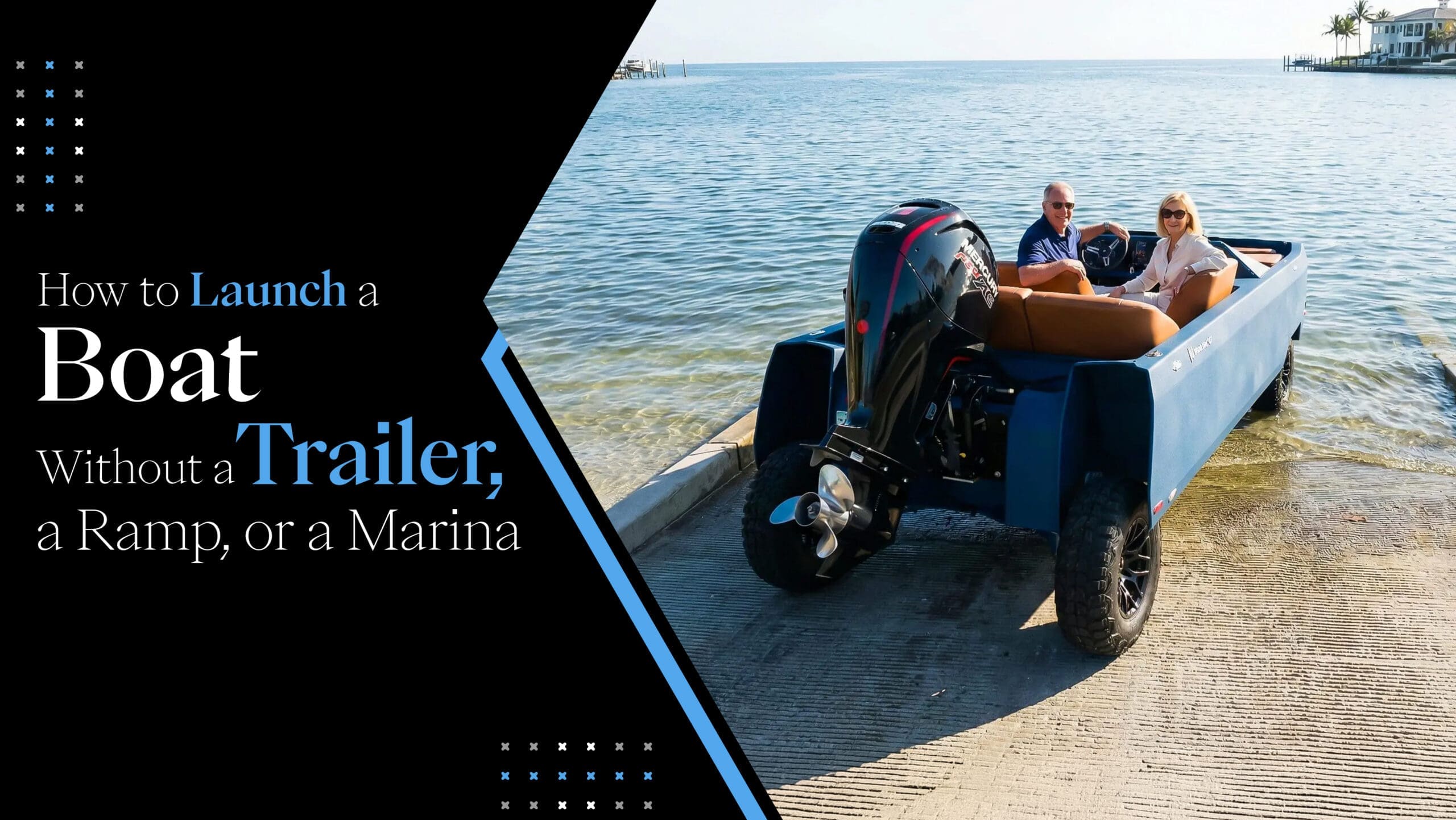


Boating activities in the past have relied on a well-known yet aggravating set of processes, including boat trailers, crowded ramps, dock fees, towing, and preparation.
Though boating brings along its promise of freedom, launching your craft does not necessarily bring that sense of liberation.
If you live near a shoreline, own waterfront property, or simply want a more flexible boating experience, the question naturally arises: how can you launch a boat without a trailer or even a ramp?
Fortunately, modern solutions are now available.
Amphibious vehicles like the WaterCar EV are introducing a completely new category of boating convenience, eliminating many of the barriers associated with traditional launches.
Yes – we’ll come to that, as we explore the limitations of traditional boats and how amphibious technology changes everything in this comprehensive read.
Traditional Boat Launching: Cost & Struggles
Traditional boating infrastructure was designed around a simple assumption: boats belong in water, and vehicles belong on land. However, for many owners, the actual launch process becomes one of the most stressful parts of the boating experience.
Let’s see how –
Trailer Dependency
A standard recreational boat typically requires:
- A dedicated trailer
- A capable towing vehicle
- Storage space
- Trailer maintenance
- Registration and insurance
Trailer boats incur additional costs due to their own requirements. Tires, bearings, brakes, lighting, and corrosion treatment need periodic care. The cumulative effect can be quite high over time.
This is why many boaters begin searching for a no-trailer boat launch solution that reduces complexity and dependency.
Crowded Boat Ramps
Public launch ramps are often congested, especially during weekends and holidays. Long waiting lines, inexperienced operators, and limited parking quickly turn a relaxing day into a stressful one.
Attempting to launch a boat without ramp access is especially important in remote areas or on waterfront properties where no public infrastructure is nearby.
Beyond inconvenience, crowded ramps can also increase the risk of:
- Trailer damage
- Boat collisions
- Backing accidents
- Delays during retrieval
Marina Fees and Storage Costs
Classic boating also includes various costs associated with marinas, which include:
- Slip rentals
- Docking fees
- Seasonal storage
- Launch service charges
Marina fees keep rising each year in many places, increasing costs for boat owners.
These are some of the factors that compel boat owners to find ways to launch their boats without using marina services.
Limited Accessibility
One of the biggest frustrations with conventional boating is that your access to water is determined by infrastructure availability.
Without a launch ramp, dock, marina, or trailer, many boats become difficult to use efficiently. The restriction limits spontaneity and flexibility.
Even if water is physically nearby, getting a traditional boat into it may still require extensive preparation.
Traditional Methods to Launch a Boat Without a Trailer or Ramp
Long before modern amphibious systems existed, boaters developed practical workarounds for difficult launch environments. Here are some of the most common boat launch alternatives used today.
Shoreline Launching from Sandy Beaches
Another traditional way is the launching of boats from beaches. On a beach with a gradual slope and solid enough sand, smaller craft can be easily launched by hand. The sandy shore launch method is suitable for:
- Small fishing boats
- Inflatable boats
- Jet skis
- Lightweight aluminum vessels
The sandy shore launch is greatly influenced by environmental factors. For example, soft sand can entrap vehicles, whereas hard rocks can damage the hulls.
Solo Launching with Long Rope Technique
Sailing by oneself requires careful planning and management. One of the most prevalent methods for sailing alone involves an elongated rope arrangement, in which the boat is steered into the water by careful manipulation from the shore.
The bowline technique is generally employed for this process. A long rope is tied at the bow end of the boat before it is put into the water. The person operating the boat gently lowers it by controlling the rope to:
- Control drift
- Prevent collisions
- Guide positioning
Such a technique is usually employed in shallow ramps or launching off the shore without access to docks.
Flatbed Truck Transport Method
For larger boats or difficult terrain, some owners use flatbed boat transport systems. Instead of a conventional trailer, the boat is loaded directly onto a flatbed vehicle and positioned near the shoreline for unloading.
This method is often used for:
- Temporary relocations
- Waterfront construction projects
- Remote property access
While practical in some situations, it still requires heavy equipment, multiple people, and careful coordination. It also does not solve the challenge of repeated day-to-day launching.
Wading Method
The wader’s boat launch method is commonly used by small-boat owners in shallow shoreline areas. The process typically involves
- Wearing waterproof waders
- Walking the boat into deeper water manually
- Stabilizing the vessel during boarding
This technique is especially popular among anglers using lightweight boats, such as inflatable boats.
Before launch, checking the boat plug is critical. Forgetting to install the drain plug is one of the most common and embarrassing mistakes among recreational boaters.
Using Alternative Equipment
A number of people use dedicated launch equipment to make launching easier. Such equipment includes:
- Portable launch dollies
- Winch systems
- Inflatable rollers
- Portable skids
- Small cranes or davits
This kind of equipment may allow for launching vehicles without the need for any tow trucks. Nevertheless, most of these alternatives will still need:
- Physical labor
- Setup time
- Maintenance
- Additional storage space
Why Traditional Boat Launching Methods Fall Short in 2026?
Even though alternative launch strategies can be effective, some of them create additional problems.
- Physical Effort: Quite a number of alternatives involve considerable physical effort to successfully launch boats. Maneuvering, stabilizing, and pushing/pulling can prove too difficult for individual users.
- Environmental Limitations: Conditions such as weather and shore greatly determine whether an alternative launch will work or not. High tide, waves, soft sand/mud, rocks, and strong wind can spoil an otherwise easy process.
- Time Consumption: Despite using different methods, boaters may end up spending more time preparing and setting up than before. In other words, their trips remain fragmented.
- Safety Risks: Launching without proper infrastructure can increase the risk of slipping, boat drift, vehicle entrapment, and hull damage. Improper launches can also create dangerous situations in crowded or unstable environments.
- Lack of Spontaneity: Perhaps the biggest issue is that traditional systems still make boating feel like an operation rather than a spontaneous activity. This is where amphibious technology introduces a major shift.
How WaterCar Eliminates Every Boat Launching Challenge Forever
Modern amphibious technology changes the entire concept of boat launching.
Instead of moving a boat into water, amphibious vehicles eliminate the separation between land and water altogether.
What is the WaterCar EV?
WaterCar has spent decades developing high-performance amphibious systems that combine the functionality of a road vehicle with the capability of a marine vessel.
The WaterCar EV is designed to:
- Drive on roads
- Enter water directly
- Transition seamlessly between environments
Unlike conventional boats, it does not require:
- A trailer
- A marina
- A public launch ramp
This makes it one of the most advanced examples of amphibious boat launch technology available today.
How WaterCar Solved All Launching Challenges?
In traditional launch methods, external equipment is used. However, this requirement is totally eliminated with WaterCar. With WaterCar:
- There’s no trailer to back up.
- No crowded ramp to wait at
- No marina storage requirement
- No complicated shoreline setup
You simply drive toward the water and enter directly. This transforms boating into a truly seamless experience.
Step-by-Step: How to Launch a WaterCar Without a Trailer, a Ramp, or a Marina
Launching an ordinary boat requires several steps: attaching a trailer, maneuvering through busy ramp sites, backing into the water, parking the towing vehicle, and going through the same steps at the end of the session.
By contrast, launching a WaterCar is designed to feel seamless and intuitive.
Here’s a closer look at how the process works.
Step 1: Drive Directly to Your Desired Shoreline
Unlike traditional boating setups that require towing a separate vessel behind a truck or SUV, the WaterCar EV allows users to drive directly to their launch location on public roads.
For many owners, this alone dramatically improves the boating experience.
Instead of being restricted to official launch facilities, users can approach a variety of accessible shoreline environments depending on local regulations and terrain conditions. This creates a much more spontaneous form of boating, especially for waterfront homeowners and coastal communities.
Step 2: Inspect Shoreline and Water Conditions
Though WaterCar eliminates the need for a ramp or marina, environmental considerations must still be taken into account. These factors include:
- Water depth near entry points
- Shoreline firmness and stability
- Entry and exit angles
- Surface traction
- Potential underwater obstacles
- Wave activity and current conditions
One of the primary advantages of amphibious vehicles is their flexibility across different shorelines. Unlike traditional boats that require steep concrete ramps, WaterCar can be used on sand beaches, gentle shores, firm coastlines, lakeshores, and even in remote places.
Step 3: Prepare the Vehicle for Water Entry
After assessing the shore, the next step is to prepare the vehicle for water travel.
The operator activates the vehicle’s amphibious transition system in accordance with standard operating procedures. Depending on the model configuration, this process may include:
- Adjusting drive settings
- Preparing marine propulsion systems
- Confirming transition readiness
- Monitoring onboard systems and indicators
This simplicity is one of the biggest reasons amphibious technology continues gaining attention among modern recreational users.
Step 4: Enter the Water Smoothly and Gradually
Following the preparation of the system, the WaterCar gradually begins its entry into the water from the shore.
This process feels dramatically different from launching a trailer boat. There is no reversing down a slippery ramp, no concern about trailer alignment, and no pressure from waiting boaters behind you.
Instead, the transition is controlled and continuous.
The operator simply drives forward at a safe, controlled speed while allowing the amphibious hull to gradually submerge. This direct-entry capability is one of the defining advantages of amphibious mobility.
As launch ramps tend to be bottlenecks, they create problems of delays, overcrowding, and frustration. The WaterCar eliminates this problem altogether, giving users the option to avoid crowded public facilities.
Step 5: Transition to Marine Propulsion and Begin Navigation
The moment the vehicle attains full buoyancy, marine propulsion begins.
From here on, the WaterCar acts like a typical recreational watercraft but with the engineering advantages of amphibious capability. It allows the users to navigate through lakes, rivers, and coastlines as any other marine craft would.
In contrast to conventional boating, one does not have to worry about:
- Trailer parking
- Ramp congestion
- Retrieval timing
- Marina closing hours
The entire experience becomes more relaxed because the logistical burden has been removed.
Step 6: Exit the Water from an Accessible Shoreline
At the end of the trip, all that is needed is to reverse the steps. Rather than heading back to a busy launching ramp or boat storage facility, the operator heads for an appropriate shore exit location and moves back onto solid ground.
The vehicle leaves the water under its own power and operates on land immediately, following the shore exit process.
Why does this change the Entire Boating Experience?
The importance of amphibious launching is not just about convenience; it’s about changing how often and how easily people use their boats.
Traditional boating infrastructure naturally creates friction:
- Trailers require maintenance
- Ramps create delays
- Marinas increase costs
- Shoreline launches require physical effort.
WaterCar reduces all these obstacles and makes transportation, as well as boating activities, seamless.
- No trailers.
- No crowded ramps.
- No marina dependency.
Just a direct transition from road to water and back again.
The Future of Boat Launching Is Simplicity
Traditional boating has delivered unforgettable experiences for generations – there is no doubt. But the launch process has always remained one of its biggest frustrations.
Trailers, launches, marinas, and beachside operations create complications that frequently hinder spontaneity and convenience.
The amphibious design revolutionizes the whole scenario.
It instantly eliminates the divide between road and water and redefines what boating can feel like – simpler, faster, and significantly more flexible.
For modern users seeking convenience, accessibility, and freedom from traditional launch limitations, our collection of custom amphibious cars represents a major step forward in the future of recreational boating.