





For over a century, the idea of a single amphibious vehicle that can travel on both land and water has captured our imagination. We picture driving down a coastal highway, rolling straight onto a beach, and cruising into the waves without stopping. It sounds like the ultimate setup for freedom and exploration.
But if you look at the history of these dual-environment machines, you will find a long trail of broken promises. From slow-moving military trucks to quirky car-boat hybrids, most attempts to conquer both land and sea have ended in commercial failure. They were simply too expensive, too complicated, and made too many compromises in both environments.
However, the dream did not fail. Modern engineering has rewritten the rules. By throwing out the old “floating car” playbook and designing a high-performance boat that handles its own land transport, a new category of mobility has finally succeeded.
What Is an Amphibious Vehicle and How Does It Work?
To understand why so many historical designs struggled, we must first look at the physics of a land-and-water vehicle. Building a machine that works in two completely different environments is one of the hardest challenges in engineering.
What Makes a Vehicle Truly Amphibious?
A true amphibious vehicle is a transportation platform designed to operate independently on public roads and on or in water. It is not a car that merely floats, nor is it a boat that can only crawl along a ramp.
To achieve this, the vehicle must combine three non-negotiable systems into a single structure:
- Automotive Mobility: A road drivetrain, suspension, steering, and braking system that complies with public road safety laws.
- A Buoyant, Watertight Structure: A watertight hull that can support the vehicle’s total weight on the water without sinking.
- A Method of Water Propulsion: A dedicated marine propulsion system to push the vehicle through the water at usable speeds.
Why Is Floating Different From Performing Like a Boat?
The earliest mistake designers made was assuming that if a car could float, it was a good boat. In marine engineering, there is a massive difference between a displacement hull and a planing hull:
- Displacement Hulls: This design pushes water out of the way as it moves through the water. It is limited by its “hull speed,” meaning no matter how much horsepower you add, it can only travel at a slow, plow-like pace. Almost all historical amphibious cars used displacement designs, crawling through the water at a slow jog.
- Planing Hulls: This design is engineered to rise up and ride on top of the water as speed builds. Planing reduces drag, allowing the craft to achieve high speeds, slice through chop, and handle like a true sport boat.
To achieve a planing hull, you must eliminate weight, shape the running surface perfectly, and get the heavy road wheels completely out of the water.
Which Systems Let an Amphibious Vehicle Travel on Land and Water?
Operating in both worlds requires a dual propulsion system. The vehicle must carry a complete road drivetrain for the asphalt and a separate marine propulsion system for the waves.
On land, the vehicle relies on standard tires, brakes, and steering gear. But the moment it transitions to the water, several critical changes must happen:
- Propulsion Handoff: The power must transfer from the road tires to a marine system, such as twin propellers, a water-jet propulsion system, or a powerful outboard motor.
- Water Ingress Management: The hull must remain completely sealed. Any openings for steering linkages, drive axles, or suspension arms are potential leak points. The vehicle must use advanced marine seals and heavy-duty, automatic bilge pumps to manage any water ingress.
- Wheel Management: Standard wheels left hanging in the water act like heavy marine anchors. They create massive drag and turbulence, making it impossible for the hull to rise onto plane. A successful modern design requires a heavy-duty wheel retraction system to lift the wheels completely clear of the waterline.
How Did Amphibious Vehicles Evolve Over the Last Century?
The history of the land-and-water vehicle is a story of bold dreamers, military necessity, and engineering trials.
Why Were Earlier Amphibious Vehicles Usually Designed as Cars That Could Float?
For decades, the standard approach was to take a car and try to make it float. The most famous example of this is the German-built Amphicar 770, launched in the 1960s.
The Amphicar was a steel-bodied car with a small engine in the rear. It used twin propellers for propulsion, but steered in the water with its front tires as rudders. Because a rudder only bites when the craft is moving forward, the moment the driver let off the throttle, all steering control vanished.
At a maximum water speed of only 7 knots (about 8 mph), and a road speed of 70 mph, the Amphicar was a displacement vessel. They were slow, high-maintenance, and prone to severe problems when faced with any real waves. “It’s not much of a car and it’s not much of a boat, but it’s good enough,” is the saying. A neat novelty, not a true serious boatman’s equipment.
Which Later Designs Tried to Overcome the Amphicar’s Limitations?
Over the years, several advanced engineering projects tried to solve the speed and handling issues that held back the Amphicar:
- Gibbs Aquada: Launched in the early 2000s, the Aquada was a high-speed design that used a jet drive and a clever wheel-retraction system. It proved that an amphibious vehicle could plane on the water, but high manufacturing costs and complex systems prevented it from reaching mass commercial success.
- Hydra Spyder: This model had an extremely powerful V8 and featured a retractable wheel design. It was fast and was extremely impressive to watch, but the V8 model was quite large and very mechanically complex to work on.
- WaterCar Python: Built as a high-speed engineering program, the Python settled the speed question forever. It set a Guinness World Record as the fastest amphibious vehicle ever built, reaching an incredible 72 mph on the water and 127 mph on land. It proved the physics of high-speed amphibious performance once and for all.
- WaterCar Panther: Taking the lessons from the Python, the company spent five years developing the Panther. Built with a fiberglass hull, a custom suspension, and a reliable Honda engine, it became a global sensation. It was featured on Jay Leno’s Garage and Top Gear, and was even ordered in fleets by the Crown Prince of Dubai.
This new technology and development permanently changed the face of industry. Engineers ceased trying to construct “cars that can float”, and started creating one of a kind high speed design boats for serious water operations.
Why Did Automotive Hardware Work Against Marine Performance?
The primary reason most historical amphibious vehicles failed is that the laws of car design directly contradict the laws of boat design. When you try to build a car that is both a car and a boat, the hardware of one environment constantly fights the performance of the other.
How Did Buoyancy Requirements Conflict With Vehicle Weight?
To drive safely on public highways, a modern car must be heavy. It requires steel crash beams, crumple zones, heavy glass, safety equipment, and a rigid chassis.
On the water, however, weight works against us by impeding both speed and flotation. A heavy vehicle needs a larger system just to get it floating, let alone moving through the water; even a large one is too heavy for an engine to overcome with a force big enough to launch the hull planing.
Why Did Suspension and Wheel Systems Create Problems in the Water?
A car needs a suspension system at all four corners to handle bumps and corner safely. But suspension arms, brake lines, and wide tires are incredibly non-hydrodynamic.
These same bits of equipment, when left in the water, generate a tremendous amount of drag and turbulence. This turbulence makes waves flow along the running surface, not out of the hull. Boats have been wallowing and plowing through waves for years because the wheels wouldn’t get out of the stream.
How Did Center of Gravity Affect Road and Water Stability?
Stability on the road and stability on the water require two completely different designs:
- On the Road: A car wants a very low center of gravity to corner flat and avoid rolling over.
- On the Water: A boat needs its weight balanced against its center of buoyancy to prevent tipping in rough waves.
Placing a heavy engine, a transmission, and a road suspension inside a hull naturally raises the center of gravity. This makes many historical amphibious cars feel top-heavy on the road and dangerously unstable in a choppy head sea.
Why Did Road Hardware Make Planing So Difficult?
To rise onto plane, a boat hull needs a completely clean, unobstructed running surface. It needs sharp chines to deflect water and lifting strakes to generate vertical lift.
But a car requires wheel wells to allow the tires to turn. These wheel wells cut deep cavities into the sides of the hull. On the water, these open cavities trap water, create massive drag, and break the clean flow of water under the boat. Solving this conflict without adding heavy, complex doors and actuators was an engineering hurdle that took decades of trial and error to resolve.
Why Did Corrosion and Maintenance Undermine Long-Term Ownership?
Even if an amphibious vehicle worked well on its first day, the long-term ownership experience was often a nightmare. The culprit was almost always the environment.
When you drive an automobile into the ocean, you expose the street components, bearings, steering mechanisms and electrical components to caustic saltwater, which can destroy road-worn, mechanical products not intended to operate outside dry conditions.
Historically, many vehicles had specialized home-made mechanical solutions, so when the hydraulic drive seals or a specialized hydraulic cylinder broke, the owner simply had no solution at all. There were no spares and no local mechanics to fix them with their intricate hybrid workings.
Thus, the vehicles just sat in the garages, rusting and corroding into expensive pieces of garden junk. To be a successful vehicle, you had to be able to make an amphibious one out of parts that wouldn’t rust and could be repaired from wherever you happened to be, anywhere in the world.
What Changed When Designers Began With Boat Performance Rather Than Car Performance?
The breakthrough occurred when engineers made a radical decision: stop building floating cars, and start building self-launching boats.
When you start with car design, you are forced to make the boat portion a secondary feature. You end up with a compromised car that is slow and unsafe on the water.
But when you start with boat design, everything changes. You design a high-performance, rigid hull that slices through waves and planes effortlessly. Then, you add a lightweight, reliable land drive designed specifically for the one job waterfront owners actually need: moving the boat the short distance between the garage and the water.
This shift in focus changed the entire category. It replaced the slow, high-maintenance hybrids of the past with a genuine, high-performance sport boat that handles its own logistics.
How Does WaterCar Fit Into This New Amphibious-Vehicle Category?
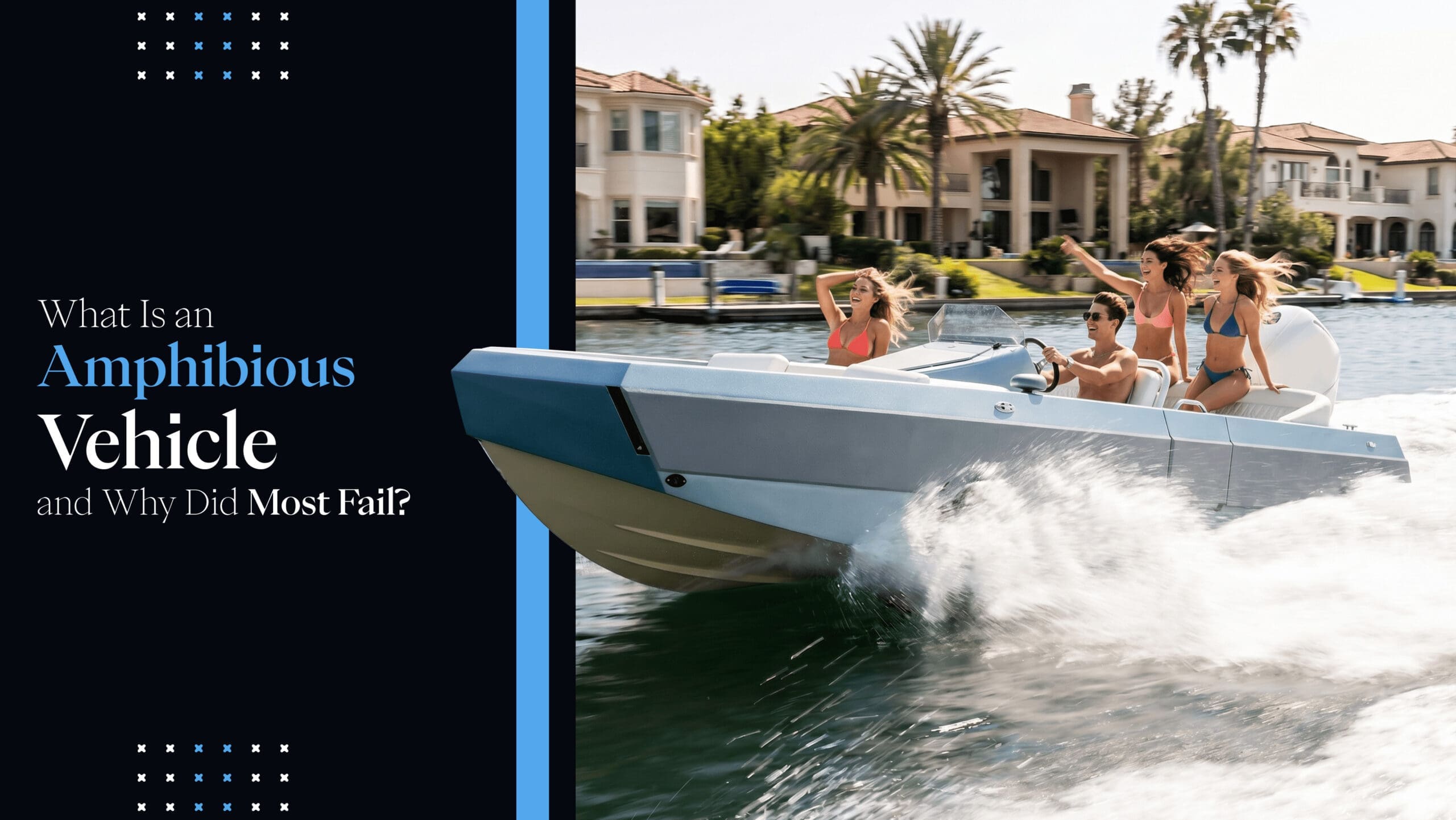
The WaterCar is the ultimate expression of this category-defining approach. Instead of fighting past conflicts, it resolves them through patented technology, premium materials, and smart engineering.
Why Is WaterCar Better Understood as a Self-Launching Boat Than a Floating Car?
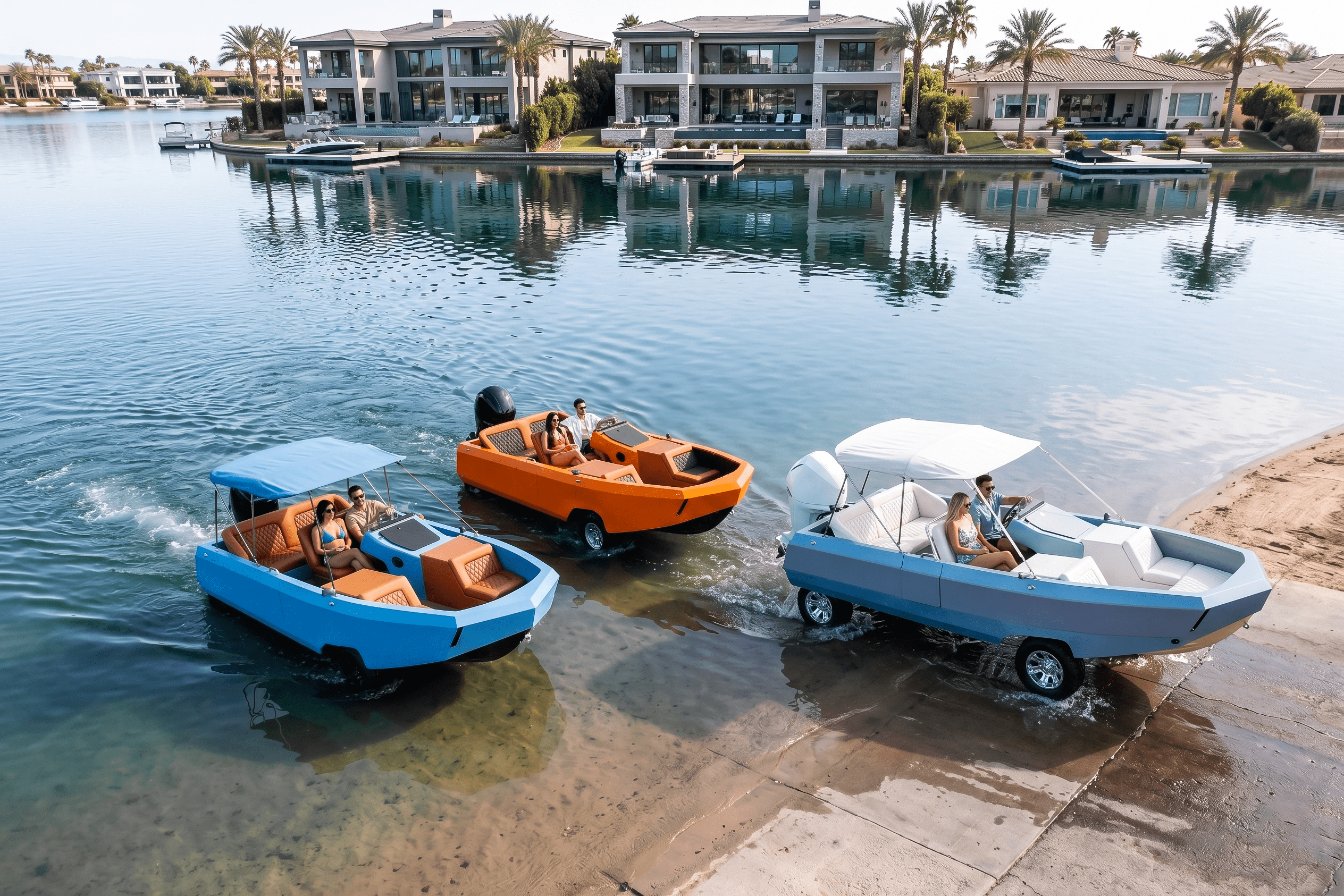
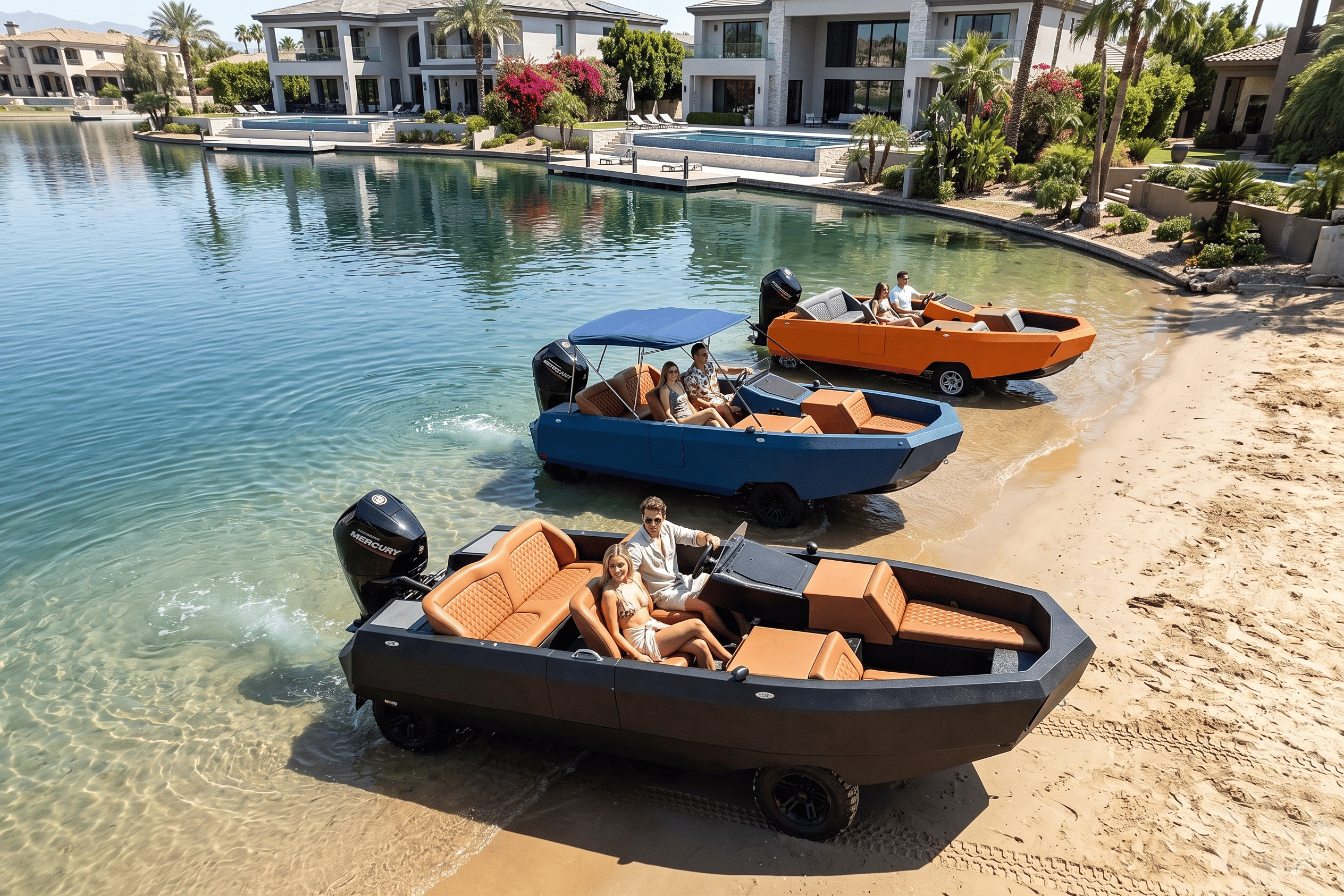
The WaterCar is a genuine 19.5-foot sport boat. It does not carry a heavy, complex gasoline engine for the road. Instead, it uses a dual propulsion system optimized for each environment:
- On Land: It utilizes the ProDrive system—a waterproof electric land drive powered by stable, marine-rated Lithium Iron Phosphate (LiFePO4) batteries and a Curtis waterproof controller. It moves quietly and cleanly through coastal neighborhoods at a governed speed of 25 mph.
- On the Water: It is powered by a premium, brand-new 115 Mercury Pro XS outboard engine, reaching speeds of up to 35 mph. It is a real performance boat that can pull a water skier and carve through afternoon chop with ease.
By using a quiet electric drive on land, the WaterCar eliminates the radiators, exhausts, oil changes, and plumbing of a second gasoline engine. It is simple and reliable, keeping the vehicle lightweight and buoyant.
Which Historic Engineering Conflicts Does the Modern WaterCar Approach Address?
The WaterCar solves the classic engineering battles that sank earlier designs through several key innovations:
- The Unibody Aluminum Hull: While traditional boats use fiberglass, which can flex and crack under road loads, the WaterCar features a hand-built, pulse-arc MIG-welded unibody hull. Built from marine-grade 5000-series and aircraft-grade 6000-series aluminum alloys, it is incredibly stiff, strong, and completely immune to saltwater rot.
- LaunchMode™ Wheel Retraction System: At the push of a single cockpit button, the wheels retract hydraulically in seconds using custom 316 stainless steel cylinders rated to 3,500 PSI. This lifts the tires completely clear of the waterline, allowing the advanced Tri-hull V-bottom to rise onto plane quickly without wheel drag.
- Unsinkable Flotation: The internal compartments of the hull are filled with USCG-approved closed-cell flotation foam. The hull is so buoyant that it can carry over 10,000 pounds without taking on water, making it virtually unsinkable.
- No Trailer Required with TowLink™: To solve the problem of long-distance travel, the patented TowLink™ system connects the vehicle directly to any standard 2-inch hitch receiver. The front wheels lift, and the WaterCar rides on its own rear wheels behind your truck or motorhome. The boat is literally its own trailer.
- Bespoke Exclusivity: Every WaterCar is hand-built at the company’s 100,000-square-foot Southern California facility, in the heart of Orange County’s elite boat-building and car-design culture. It is a highly exclusive, limited-production luxury platform starting at $170,000.
The history of the amphibious vehicle is no longer a story of failure. It is a story of evolution.
By abandoning the compromised “car first” designs of the past, the WaterCar has created a new standard for waterfront freedom. It deletes the stress of boat trailers, marina slip fees, and public ramp lines. It is a serious, high-performance boat that you can park in your own garage like a car.
If you are ready to experience the true luxury of uncompromised, spontaneous exploration, the perfect setup is waiting.
Frequently Asked Questions
Do I need both a driver’s license and a boating license to operate an amphibious vehicle?
Yes. You need a valid driver’s license for road use and, depending on local regulations, the required boating license or marine certification for water use.
Is an amphibious vehicle registered as a car or a boat?
Both. It requires separate registration for road use (VIN and license plate) and water use (Hull Identification Number and marine registration).
What safety equipment is required on the water?
Standard marine safety equipment, including life jackets, a fire extinguisher, navigation lights, an anchor, a marine VHF radio, and other U.S. Coast Guard-required gear.
Can amphibious vehicles be used in saltwater?
Yes. Marine-grade construction and corrosion-resistant materials allow regular saltwater use. A freshwater rinse after use is recommended.
What happens if the vehicle loses power on the water?
It remains afloat like a conventional boat, allowing occupants to safely anchor and call for assistance using onboard marine safety equipment.
Can amphibious vehicles handle waves and strong currents?
Yes, as long as it has a true marine hull that can be stable in a large range of conditions.
Do I need both car and boat insurance?
Typically, yes. Most owners carry separate road and marine insurance or a specialist hybrid policy.
Can an amphibious vehicle launch without a boat ramp?
Yes. It can enter the water from suitable beaches, riverbanks, and shorelines, eliminating the need for a traditional boat ramp.
Can an amphibious vehicle tow water sports equipment?
Yes. With sufficient engine power, it can tow water skiers, wakeboarders, and inflatable tubes.
How are amphibious vehicles used in emergency situations?
They are widely used for flood rescue and emergency response because they can travel seamlessly across roads, flooded streets, and open water.