



What Was the Original Panther Water Car?
The original WaterCar Panther was the first production amphibious vehicle developed by WaterCar after years of experimental work.
Its development followed the WaterCar Python, a high-performance prototype that demonstrated how fast an amphibious vehicle could travel. The Panther pursued a different objective: to take the lessons learned from that engineering program and create a vehicle that people could actually own and use. WaterCar’s current history places the Panther’s commercial launch in 2013, after 14 years of development.
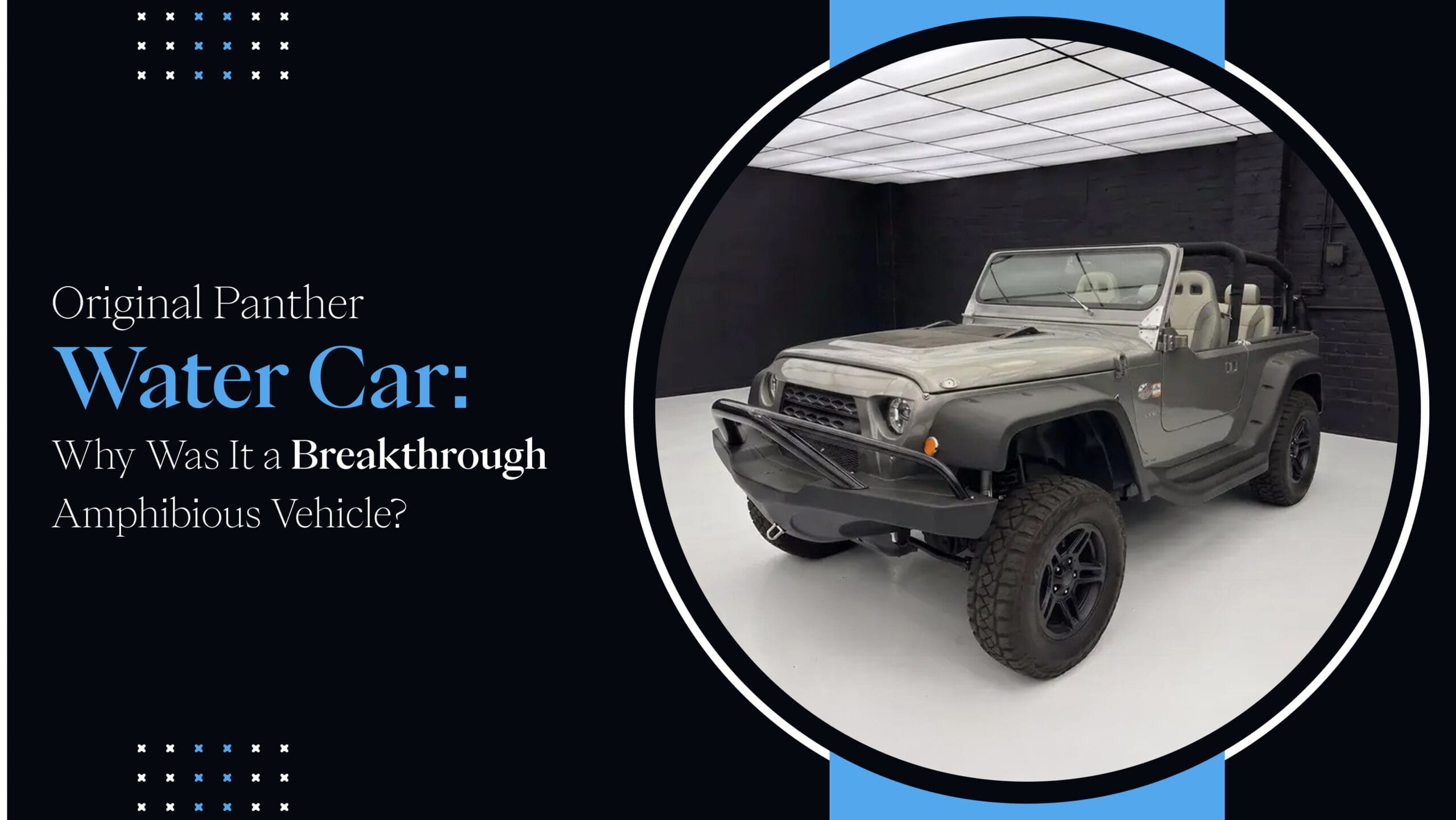
The result looked familiar at first glance. Its styling drew heavily from the Jeep CJ family and gave the vehicle the appearance of an open-top off-road machine.
Underneath, however, the architecture was very different.
The Panther combined:
- A chromoly-steel chassis
- A fiberglass hull and body
- A rear-mounted V6
- Four-wheel hydraulic suspension
- Retractable wheels
- A four-speed manual transmission for road use
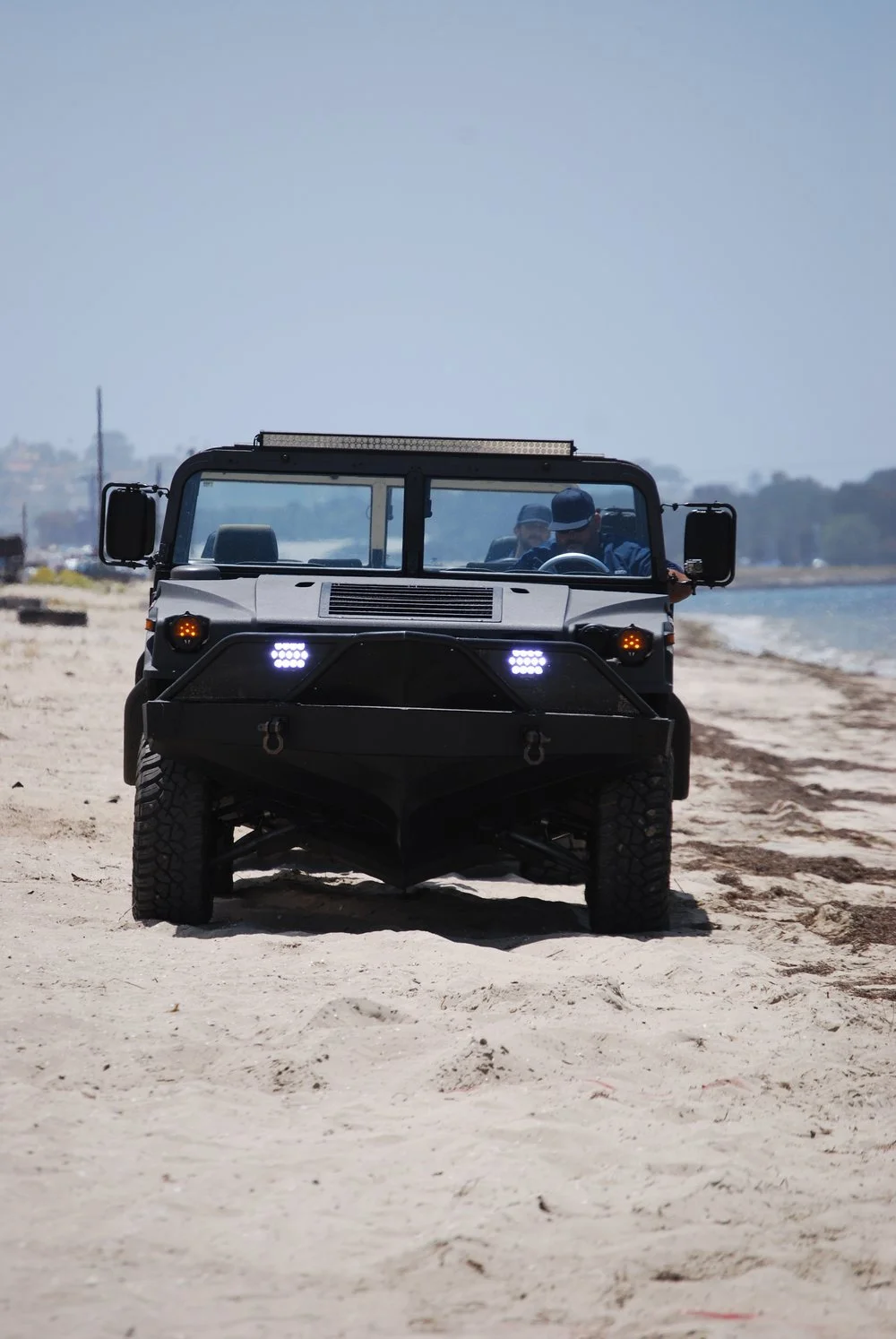
- A dedicated Panther jet drive for water propulsion
- Closed-cell flotation foam within the hull
Contemporary technical reporting listed the Panther at approximately 2,950 pounds, with seating for four.
What Problem Was the WaterCar Panther Designed to Solve?
The Panther grew out of a simple observation by WaterCar founder Dave March: being able to float was not enough.
March had restored a 1961 Amphicar with his son. When they took it onto the water, its modest marine performance exposed the compromises built into many earlier amphibious cars. WaterCar’s current founder story says that experience led March toward a different goal—an amphibious vehicle that could perform at the level of a genuine automobile and a genuine boat.
The Panther therefore addressed several familiar amphibious-vehicle compromises:
Earlier approach:
- Make the car watertight.
- Add water propulsion.
- Accept limited marine performance.
Panther approach:
- Build around a lightweight hull.
- Create meaningful water propulsion.
- Retract the wheels.
- Develop suspension suitable for land and water transitions.
- Give the vehicle enough power to perform on both surfaces.
That distinction is important to understanding the Panther’s place in WaterCar Panther history.
It wasn’t simply an attempt to make an existing car float.
It was an attempt to make an amphibious car that could function convincingly in both environments.
Was the WaterCar Panther Just a Modified Jeep?
No.
The Jeep-inspired appearance is one of the Panther’s most recognizable characteristics, but the underlying vehicle was substantially different from a conventional Jeep.
Contemporary reporting described the Panther as being developed by Fountain Valley Bodyworks on a chromoly frame integrated with a fiberglass hull. The vehicle’s wheels could retract hydraulically, and its marine propulsion came from a dedicated jet drive.
The distinction becomes clearer when you look beneath the body.
A conventional Jeep is fundamentally a land vehicle.
The Panther had to accommodate:
- A watertight hull
- Flotation
- Marine propulsion
- Retractable wheels
- Marine cooling
- Bilge systems
- Waterborne steering and control requirements
The Jeep influence was primarily visible in the Panther’s styling and off-road character.
The engineering objective was distinctly amphibious.
How Was the Panther’s Drivetrain Configured?
The answer becomes even clearer when looking at its drivetrain.
The Panther was engineered around a single engine that could provide propulsion in two environments, with the drivetrain configured differently for land and water.
That was one of its defining engineering characteristics.
How Did One Engine Power Both Land and Water Travel?
The Panther used a rear-mounted 3.7-liter V6, commonly identified in contemporary reports as an Acura/Honda V6 producing approximately 305 horsepower. On land, the engine sent power through a four-speed manual transmission to the rear wheels. On water, a transfer case redirected engine power to the Panther jet drive.
In simplified terms:
Land
Engine → manual transmission → rear wheels
Water
Engine → transfer case → Panther jet drive
That architecture allowed the Panther to use one powerplant without requiring a separate marine engine.
It also meant that the driver wasn’t carrying two completely independent propulsion systems.
What Was the Panther Jet Drive?
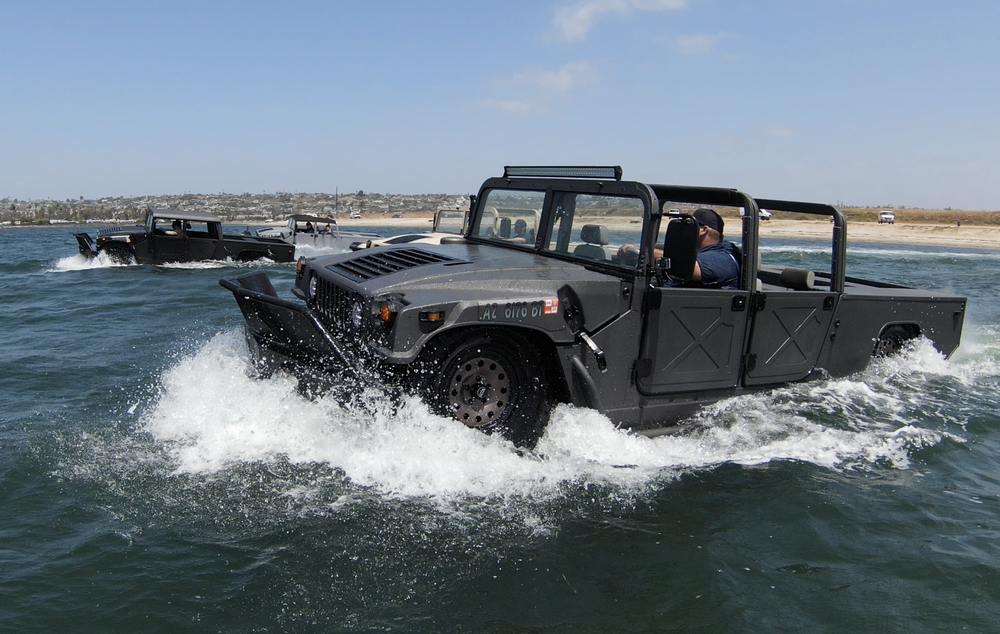
The Panther Jet was the vehicle’s dedicated marine propulsion system.
Instead of using a conventional propeller beneath the hull, the Panther directed engine power to an internal jet-drive system.
This provided several advantages for an amphibious vehicle.
A jet drive:
- Keeps the main propulsion hardware integrated into the vehicle.
- Avoids an exposed conventional propeller.
- Works with the Panther’s retractable-wheel architecture.
- Allows the vehicle to operate without a conventional stern drive.
WaterCar’s later technical material explains that its earlier high-performance amphibious prototypes used internal jet drives before the company eventually moved to an outboard-powered architecture for the current generation. The Panther therefore represents an important stage in WaterCar’s engineering evolution.
The jet drive was particularly suited to the Panther’s objective at the time: combine off-road mobility with high-speed water performance in one package.
Why Was the Engine Mounted at the Rear?
The rear-mounted engine was central to the Panther’s layout.
It allowed the engine and drivetrain to remain concentrated around the rear of the vehicle while providing relatively direct paths to both propulsion modes.
- On land, power could travel through the manual transmission to the rear wheels.
- On water, the transfer case could redirect power to the jet drive.
The rear-engine arrangement also complemented the Panther’s open, boat-like forward hull and allowed the vehicle to maintain a relatively compact mechanical package.
Most importantly, it supported the central WaterCar concept:
One vehicle. One powerplant. Two propulsion paths.
Why Were the Panther’s Retractable Wheels So Important?
The Panther’s retractable wheels were more than a visual trick.
They solved one of the fundamental problems of amphibious vehicle design: road wheels create drag when they are exposed to the water.
The Panther used a hydraulic suspension system that raised the wheels clear of the water.
Contemporary reporting described the wheel system as capable of retracting the wheels in less than eight seconds, while the complete land-to-water transition could be accomplished in under 15 seconds.
When the wheels were retracted:
- Their drag was reduced.
- The hull could interact more cleanly with the water.
- The vehicle’s marine propulsion could operate without road wheels interfering with the water flow.
- The Panther could adopt a more boat-like configuration.
The system also addressed a practical off-road requirement.
The Panther wasn’t designed simply to drive from a paved road onto a boat ramp. Its hydraulic suspension contributed to its ability to approach the water over varied terrain.
That combination – off-road suspension on land and retracted running gear on water – was a defining part of the Panther’s design.
How Did the Panther Transition From Land to Water?
The Panther’s transition was a mechanical sequence rather than a simple switch between driving modes.
Contemporary descriptions outline a process in which the vehicle entered the water, changed the drivetrain configuration, and hydraulically raised its wheels.
The basic sequence was:
- Approach the water on its wheels.
- Enter the water and allow the hull to float.
- Place the road drivetrain in the appropriate neutral configuration.
- Engage the transfer case for the jet drive.
- Hydraulically retract the wheels.
- Begin marine operation using the Panther jet.
The reverse process returned the vehicle to road configuration.
That sequence solved a problem that earlier amphibious cars often handled less effectively: the vehicle had to transition from being a wheeled vehicle to being a functioning watercraft without requiring a trailer, crane, or separate marine propulsion system.
The Panther’s system made the transition part of the vehicle itself.
How Did the Original Panther Perform on Land and Water?
The Panther was notable because its performance was strong in both environments.
Reported specifications vary slightly depending on the source and individual vehicle, but the commonly cited launch-era figures are approximately 80 mph on land and 44–45 mph on water. Contemporary technical coverage reported 80 mph on land and 44 mph on water, while WaterCar and later references have commonly cited approximately 45 mph on water.
| Land speed | Up to approximately 80 mph |
|---|---|
| Water speed | Approximately 44–45 mph, depending on source |
| Engine | 3.7-liter Honda/Acura V6 |
| Power | Approximately 305 hp |
| Water propulsion | Panther marine jet drive |
| Road propulsion | Rear wheels through a 4-speed manual transmission |
| Transition time | Less than approximately 15 seconds |
| Wheel retraction | Less than approximately 8 seconds |
| Construction | Chromoly-steel chassis with fiberglass hull/body |
| Reported weight | Approximately 2,950 lb |
| Seating | Four |
These figures should be treated as representative rather than universal specifications for every Panther ever built. Later individual examples used different engines and configurations, and used-market documentation shows Panthers equipped with powerplants other than the commonly cited Acura/Honda 3.7-liter V6.
That variation is part of the Panther’s story.
Each vehicle was hand-built rather than produced like a conventional mass-market automobile.
Why Was the Panther Faster Than Many Earlier Amphibious Cars?
The difference becomes obvious when the Panther is compared with the Amphicar, the vehicle that helped inspire Dave March’s work.
The Amphicar was an important milestone because it successfully entered series production as a civilian amphibious automobile. But its water performance was modest by modern standards.
The Amphicar used a 43-hp Triumph engine and twin propellers, with a published water speed of roughly 7 mph and a land speed around 70 mph.
The Panther approached the problem differently.
It had:
- Approximately 305 hp
- A dedicated jet propulsion system
- A lightweight structure
- Retractable wheels
- A purpose-designed hull
- A much higher power-to-weight ratio
The result was a reported water speed of roughly 44–45 mph.
That comparison illustrates the change in engineering philosophy.
The Amphicar demonstrated that an automobile could operate on water.
The Panther demonstrated how much further an amphibious vehicle could go when water performance became a primary engineering objective.
WaterCar’s own history describes the Panther as the product of the lessons learned from the earlier Python program and 14 years of development.
How Did the Panther Balance Road, Off-Road and Marine Use?
The Panther wasn’t designed around a single operating environment.
Its design had to accommodate three.
On the road
The Panther offered:
- Rear-wheel drive
- Four-wheel disc brakes
- Manual transmission
- Automotive steering
- Road-oriented suspension
- Up to approximately 80 mph of reported road performance
Off-road
Its Jeep-inspired design and hydraulic suspension gave it a more capable recreational character away from paved roads.
The retractable suspension was particularly useful because the wheels needed to operate normally on land and disappear from the water once the vehicle entered marine mode.
On the water
- The Panther relied on:
- A fiberglass hull
- Closed-cell flotation
- Jet propulsion
- Retractable wheels
- Marine systems
- A water-oriented control configuration
The key wasn’t making each system perform every job.
It was separating the requirements while keeping them within one vehicle.
That principle remains visible in WaterCar’s current engineering. The modern WaterCar EV uses a dedicated electric land-drive system and Mercury outboard marine propulsion rather than forcing one propulsion system to perform both jobs.
Why Was Each WaterCar Panther Different?
The Panther was hand-built, and that matters when looking at its surviving examples today.
Unlike a mass-produced automobile with one fixed specification sheet, Panthers can differ in:
- Engine
- Interior
- Exterior finish
- Equipment
- Suspension configuration
- Instrumentation
- Accessories
- Registration history
Recent auction examples illustrate that variation.
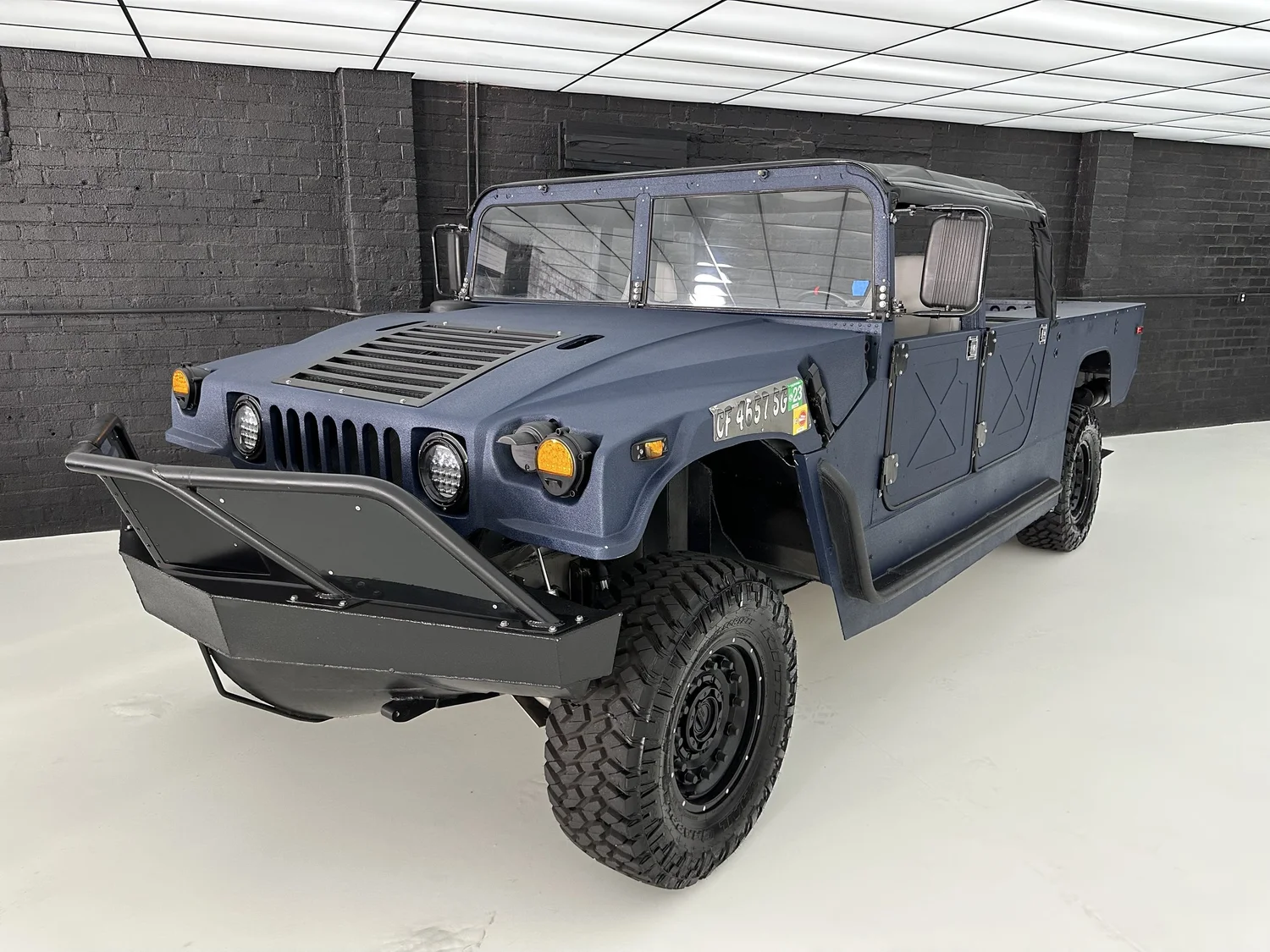
One Panther sold in 2025 had the familiar Acura 3.7-liter V6, four-speed manual transmission, and Panther jet drive. Another earlier example documented through Bring a Trailer used a Subaru 2.5-liter flat-four with a Volkswagen-sourced four-speed transmission.
That means the phrase “original Panther” should not be interpreted as one perfectly identical specification.
The better way to understand the Panther is as a production family built around a common amphibious architecture.
What Did the Panther Prove About Amphibious Vehicle Engineering?
The Panther demonstrated several principles that continue to influence WaterCar’s approach.
1. A serious amphibious vehicle needs genuine marine propulsion.
Simply turning the wheels in water isn’t enough for high-speed performance.
The Panther’s dedicated jet drive gave it a propulsion system designed specifically for water.
2. Road hardware needs to get out of the water.
Retractable wheels reduced the compromise between road and marine operation.
3. Weight matters.
An amphibious vehicle has to carry two sets of requirements. Keeping the structure relatively light is therefore critical.
4. The hull cannot be an afterthought.
The Panther’s fiberglass hull formed a fundamental part of its water performance rather than simply providing flotation around an automotive chassis.
5. One vehicle can have different propulsion paths.
The Panther used its engine differently depending on the environment, directing power to the rear wheels on land or to the jet drive on water.
Those principles helped move amphibious engineering away from the idea of a novelty car that happens to float.
They pointed toward a more integrated approach: engineer the vehicle and the boat as one system.
Why Has the Original Panther Become Collectible?
The Panther occupies an unusual position in automotive and marine history.
It combines several characteristics that rarely exist together:
- Limited production
- Hand-built construction
- Distinctive Jeep-inspired styling
- Unusual amphibious engineering
- High water performance for its era
- A documented WaterCar lineage
- A connection to the company’s first commercial production vehicle
Its rarity is also becoming easier to see in the secondary market.
Recent Bring a Trailer listings show Panthers selling for $87,000, $102,000 and $124,000, depending on the individual vehicle and its condition, history and specification. These are individual auction results—not a universal market value.
For collectors, the appeal is therefore not simply that the Panther is unusual.
It represents an important chapter in the development of modern amphibious vehicles.
It was the production vehicle that followed WaterCar’s record-setting Python and helped establish the company’s reputation before the current EV generation.
Can You Still Buy an Original WaterCar Panther?
You cannot order a new Panther as part of WaterCar’s current production lineup.
WaterCar’s current product focus is the WaterCar EV, while the Panther is now encountered primarily through the secondary market. Contemporary reporting also notes that new Panther production ended and that used examples became the route for prospective buyers.
Used Panthers do still appear through specialist dealers and collector auctions.
However, buying one requires more due diligence than purchasing a conventional used car.
A prospective buyer should verify:
- Vehicle identification: VIN and HIN documentation
- Engine: Which engine is actually installed
- Marine propulsion: Condition of the Panther jet system
- Wheel retraction: Hydraulic operation and seals
- Hull: Fiberglass condition and repairs
- Chassis: Corrosion or structural damage
- Bilge and flotation systems
- Road registration
- Watercraft registration
- Maintenance history
- Previous modifications
Recent auction documentation shows that Panther titles and model-year descriptions can vary between vehicles, making it particularly important to verify the paperwork and provenance of an individual example rather than relying solely on the Panther name.
For collectors, that history is part of the appeal.
For buyers, it is part of the inspection process.
The Panther water car – A Breakthrough
WaterCar took the lessons of the Amphicar and its own Python development and applied them to a vehicle intended for real production. The result combined a lightweight fiberglass hull, chromoly chassis, rear-mounted V6, manual road drivetrain, dedicated jet propulsion, and hydraulically retractable wheels.
Its reported performance – approximately 80 mph on land and 44–45 mph on water – was a major departure from the modest water speeds associated with earlier civilian amphibious cars.
More importantly, the Panther established a design philosophy that remains recognizable in WaterCar today:
Build the boat seriously. Build the vehicle seriously. Then engineer the transition between them.
That is what made the original Panther more than a Jeep-shaped car boat.
It became one of the defining examples of modern WaterCar amphibious vehicle engineering.