
Why Superyacht Owners Are Replacing Their Tenders With Amphibious Vehicles?

Superyacht ownership is about the pursuit of freedom.

However, getting guests from ship to shore has always been a challenge. Modern superyachts are advanced, but traditional transportation methods between the vessel and shore remain problematic.

Traditionally, getting to a remote coast or port required a RIB or normal tender, which resulted in soggy landings, logistical difficulty, and reliance on marinas.

Why Superyacht Owners Are Replacing Their Tenders With Amphibious Vehicles?

At a Glance

  • Amphibious vehicles eliminate wet beach landings by allowing guests to stay seated while driving directly from the water onto the shore without docks or marinas.
  • Unlike traditional RIB tenders, amphibious vehicles continue onto public roads, giving superyacht owners direct access to resorts, restaurants, and coastal destinations.
  • They reduce crew workload and speed up shore transfers by removing the need to coordinate separate land transportation after reaching the beach.
  • Storing an amphibious tender out of the water minimizes corrosion and maintenance, helping reduce long-term ownership costs compared to conventional tenders.
  • When choosing an amphibious tender, prioritize marine certification, road legality, hull design, and safety features to ensure reliable performance in both environments.

Showcase

Our Gallery

Owners now seek independence, resulting in the rapid adoption of amphibious tenders.

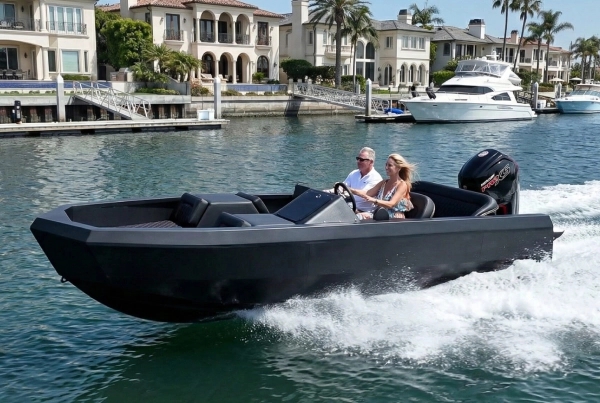
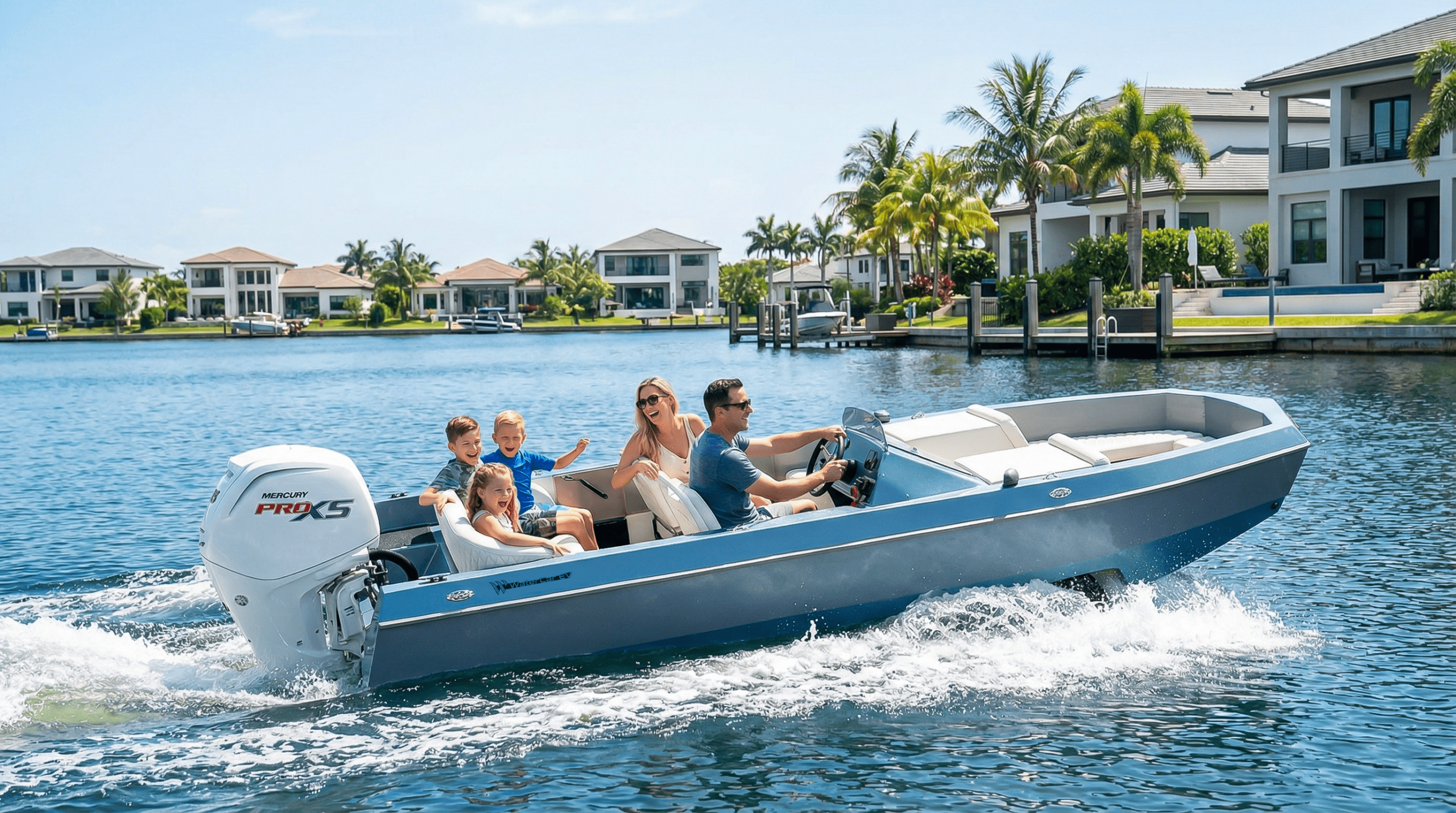
Advanced dual-environment platforms bridge ocean and land, removing transfer friction. The WaterCar EV exemplifies this innovation as a meticulously engineered superyacht amphibious vehicle.

Let’s explore.

What Are Amphibious Vehicles, and How Do They Work for Superyachts?

Engineers design amphibious vehicles to operate on both land and water using integrated automotive and marine propulsion systems.

Superyacht owners use them as the ultimate expedition tenders, disembarking from their anchored mothership, cruising across water, and driving directly onto the shore without ever needing a dock or transfer.

Are Amphibious Yacht Tenders Actually “Real Boats”?

Many people mistakenly believe that an amphibious vehicle merely modifies a novelty car to float. While this may apply to DIY kits or recreational gimmicks, premium luxury amphibious crafts serve as uncompromising marine vessels.

The WaterCar EV is a 19-foot sport boat powered by a 115 Mercury Pro XS outboard, reaching up to 35 mph. Built to US Coast Guard standards, it delivers authentic marine performance.

What’s the Difference Between Traditional Tenders and Modern Amphibious Luxury Vehicles?

Traditional tenders rely on single-environment capability; their function ends when the water becomes too shallow. Guests must wade through the surf or wait while the crew secures a marina slip.

A modern amphibious vehicle uses a patented system for seamless land-to-water transitions. At the push of a button, owners deploy the wheels, letting it drive from ocean to beach. This creates a fluid, non-marina-access experience, removing the boundaries of traditional superyacht tenders.

Why Are Superyacht Owners Making the Switch From Traditional Tenders?

The desire to elevate the guest experience and streamline yacht operations drives the transition toward amphibious mobility.

How Do Amphibious Tenders Eliminate Dangerous Wet Beach Landings?

Wet beach landings create one of the greatest points of friction in yachting. Forcing elegantly dressed guests to step from a bobbing tender into unpredictable surf undermines refinement. Amphibious mobility gives superyacht owners the ultimate dry-beach landings. Guests remain comfortably seated as the vehicle simply drives out of the water and parks safely on solid ground.

Not all amphibious systems are equal. Many early track-based tenders and super-beachers had flat-bottomed hulls to suit their ground tracks, which reduced rough-water performance. The WaterCar EV has a Tri-hull V-bottom design with a reverse chine and accurate deadrise geometry. This integrated structure enables WaterCar EV to level fast, cut through wakes, and chop with stability, resulting in improved handling compared to track- or wheel-based systems.

What Makes Remote Beach Access Possible With Amphibious Tenders?

True remote beach access yachting demands more than merely reaching the sand; it requires the ability to continue inland. Here, the WaterCar EV establishes category leadership.

Unlike amphibious RIBs limited to shore, the WaterCar EV is a street-legal Low-Speed Vehicle (LSV / NEV). This lets you drive from your yacht onto roads and park at properties or resorts without needing extra transport.

How Do Amphibious Vehicles Improve Crew Operational Efficiency?

Launching a traditional heavy tender requires significant crew coordination, crane operation, and logistical planning. If the owner wishes to explore inland, the crew must coordinate a separate terrestrial vehicle for onshore use.

Operations are simple with amphibious vehicles. WaterCar EV switches into a street-legal electric vehicle, so no transport needs to be arranged, making life simpler and leaving the crew to provide hospitality.

What Are the Long-Term Maintenance and Cost Advantages?

Traditional tenders that sit in water or are dragged onto beaches degrade quickly. The WaterCar EV is designed for durability, featuring a high-strength aluminum superstructure refined for the ocean.

The aluminum unibody hull is epoxy-coated to resist saltwater and filled with US Coast Guard-approved foam, making it virtually unsinkable. Owners can park it securely on land or store it in a yacht’s garage, avoiding the constant corrosion that affects traditional vessels.

How Do Amphibious Vehicles like Watercar Compare to Traditional RIB Tenders?

When you evaluate an amphibious boat versus a RIB tender, you distinctly see the contrast in luxury and capability.

  • Structural Integrity: Traditional Rigid Inflatable Boats use air-filled pontoons, making them vulnerable to punctures. In contrast, the WaterCar EV uses a rigid, marine-grade aluminum hull for superior strength and durability.
  • The Guest Experience: Riding on a RIB frequently involves exposure to water and a utilitarian, less comfortable voyage. In comparison, the WaterCar EV offers a very comfortable ride in a 19-foot boat, with a premium cabin crafted from refined materials and finished with skilled craftsmanship.
  • Mobility: While a RIB stops at the shoreline, leaving travelers stranded, the WaterCar EV uses its electric land propulsion system to continue smoothly from the beach onto local roads. It allows quiet, clean travel at governed speeds of up to 25 mph beyond where RIBs can go.

The Key Benefits of Amphibious Vehicles

For wealthy buyers, ownership of a WaterCar is about liberty and simplicity. Benefits are:

  1. Unrestricted Exploration: Owners move easily between water and land, discovering secluded coves, sandy shallow areas, and personal islands that big, deep keel boats can’t navigate.
  2. Absolute Spontaneity: Owners can launch on command, eliminating the waiting for marina availability and the tender transfer inconvenience.
  3. Elite Status: The spectacle of a vehicle emerging from the ocean and onto the road commands extraordinary attention. Owners gain a level of exclusivity and prestige that traditional tenders cannot match.

What Sets Watercar Apart in the Amphibious Vehicle Market?

Several conceptual prototypes and industrial utility craft make up the amphibious vehicle market, but WaterCar sets the benchmark for premium amphibious mobility.

WaterCar EV stands out for its high production accuracy and its limited status. It is produced on a small scale, with each vehicle built by hand to a level of meticulousness comparable to that of a private jet or supercar. The car, which costs $170,000, is geared toward someone looking for something completely unique.

Why Is Watercar the Future of Superyacht Tender Innovation?

The superyacht industry now sees the rise of support yachts—separate, massive vessels dedicated entirely to carrying submarines, helicopters, and tender fleets. However, true innovation in mobility doesn’t just involve carrying more vehicles; it requires carrying smarter vehicles.

WaterCar is the future of marine mobility. By incorporating automotive compliance into a marine solution in an efficient, innovative package, it delivers customized tender solutions and helps eliminate the ‘fleet clutter’ of the marine sector.

How Should Superyacht Owners Choose an Amphibious Vehicle?

There is a need for owners and captains to require engineering credibility when choosing an amphibious tender: they should verify the:

  • Marine Certification: Is the vehicle engineered to meet U.S. Coast Guard standards?
  • Road Legality: Can the vehicle legally drive on public roads, or is it restricted to private beaches? (The WaterCar EV is fully DOT-approved for LSV/NEV use.
  • Hull Design: Does it feature an advanced V-bottom for rough water, or a flat bottom that will slam into waves?
  • Safety: Is the hull unsinkable? (The WaterCar EV features USCG-approved integrated foam).

Why Watercar Represents the Ultimate Amphibious Solution for Superyacht Owners

Superyacht owners do not compromise on their primary vessels, and they should no longer compromise on their ship-to-shore experience. The WaterCar EV defines the future of amphibious mobility by combining precision engineering, marine-grade technology, and luxury automotive craftsmanship. It effortlessly resolves the historical limitations of wet landings and marina dependency, replacing them with seamless, sophisticated adventure.
Enhance your superyacht’s capabilities and explore the future of seamless amphibious mobility.

Frequently Asked Questions (FAQ)

Frequently Asked Questions

The WaterCar EV operates efficiently across both mediums, enabling incredibly fast deployment. Simply lowered from the tender garage, or craned from the superyacht deck, and in the water, the vehicle will retract its wheels and engage marine mode with the touch of a button. Forget about ferrying passengers to shore and organizing an awaiting ground-based vehicle.

While heavily mechanized track systems can suffer from salt and sand intrusion, the WaterCar EV utilizes an advanced, precision-engineered wheel system integrated into a high-strength aluminum superstructure. Because the vehicle is built with marine-grade materials and an epoxy-coated hull, the system is designed to withstand harsh saltwater environments for the long term, requiring only standard routine maintenance.

Yes. Unlike flat-bottomed amphibious craft, the WaterCar EV is engineered for confident handling in open water. It utilizes an advanced Tri-hull V-bottom design with a reverse chine and precision dead rise geometry. This ensures the vehicle planes quickly and slices through heavy boat wakes and afternoon chop, providing the stable, secure feel of a much larger sport boat.

The WaterCar EV sits in two regulatory worlds. Designed for NHTSA highway and US Coast Guard marine standards. It will normally carry a combination policy, and because the vehicle is properly stored in the superyacht’s garage or securely on land, it will have no “at risk” boat insurance surcharge.

The watercar EV was manufactured to perform in rough seas. The unibody, all-aluminum hull is then epoxied to give the watercar superior resistance to the extreme conditions of heavy-saltwater environments. Wash the car down with fresh water after usage to keep the vehicle looking sharp.

The operation is designed to be highly intuitive. On the water, it operates like a standard, high-performance 19-foot sport boat powered by a familiar 115 Mercury Pro XS outboard motor. On land, the electric propulsion drives with the simplicity of a standard EV. Crew members will only need standard maritime captain certifications required by their jurisdiction, with a minimal learning curve for the push-button transition system.

They are the ultimate solution for shallow-draft exploration. Because the wheels can be deployed, the WaterCar EV can navigate shallow tidal flats, protected mangroves, and secluded sandbars where traditional deep-draft tenders and jet boats would instantly run aground or ingest debris.

Because WaterCar intentionally limits production each year to create bespoke, one-of-a-kind vehicles, the platform retains exceptional exclusivity and value. Traditional RIBs are mass-produced commodities that depreciate rapidly. The rare, handcrafted nature of the WaterCar EV—starting at $170,000—ensures strong market appeal among affluent buyers.

Yes. The WaterCar EV is 19 feet long. It will fit easily into most current superyacht & support vessel garages, davits, or hydraulic swimming platforms.

The WaterCar EV will never be an obsolete vehicle because its propulsion relies on standard, widely available, industry-tested components. A tried-and-true 115 Mercury Pro XS outboard powers it on the water, and DOT-approved 24-volt EV components are standard on the LSV version.
These components will keep your boat fixable forever with the world’s certified marine mechanics and EV technicians.

Reserve Your Build Slot

Your $5,000 deposit reserves a build slot for the WaterCar EV and is credited toward your purchase price. Build slots are allocated in the order deposits are received.

Your deposit is refundable.

To pay by wire transfer, email info@watercar.com for instructions, which are verified by phone with our Business Manager.

Your reservation is protected by our Deposit Agreement

Prefer to pay by wire? Request wire instructions

Have you read the deposit agreement?

This Watercar, Inc. Deposit Agreement (the “Deposit Agreement”) governs the placing of a reservation and making a deposit with Watercar, Inc. for a test drive and potential purchase of a Watercar EV Vessel (the “Watercar EV Vessel”). Please read all of these terms and conditions carefully before signing this Deposit Agreement and submitting your deposit. This is a binding agreement between you (the “Buyer”) and Watercar, Inc.

This Deposit Agreement outlines the reservation and deposit terms for a Watercar EV Vessel. Your reservation becomes effective only once you have paid the deposit amount listed below to Watercar, Inc., and the order of delivery will be determined on a first-deposit, first-delivery basis. This Deposit Agreement is subject to the following terms:

Model: Watercar EV*

Deposit Amount: $5,000.00

Deposit Refundable: The Deposit Amount is refundable up until a Purchase Agreement is entered into between Buyer and Watercar, Inc. for the ultimate purchase of a Watercar EV Vessel.

Transferable: This Deposit Agreement can be assigned by you to another purchaser upon the written consent of Watercar, Inc. and is subject to the terms and conditions of this Deposit Agreement.

* The Watercar EV Vessel details and specifications may vary from your Watercar EV Vessel and are subject to change without notice, and will be confirmed prior to start of production.

Now, therefore, in consideration of the mutual covenants set forth herein and other good and valuable consideration, Watercar, Inc. and Buyer agree as follows:

1. DEPOSIT. By entering into the Deposit Agreement, Buyer agrees to pay Watercar, Inc. the Deposit Amount set forth above for the placing of a reservation and a test drive of one Watercar EV Vessel. By agreeing to these terms and conditions, you represent and warrant to Watercar, Inc. that you are at least 18 years of age. If you are reserving a Watercar EV Vessel on behalf of a company, organization, or entity (the “Entity”), you represent and warrant that you have the authority to bind that Entity to this Agreement and that such Entity agrees to be bound by this Deposit Agreement.

2. TEST DRIVE. To schedule a test drive of a Watercar EV Vessel, Watercar, Inc. requires any Buyer or perspective buyer to make a deposit payment pursuant to the terms of this Agreement and execute a separate agreement entitled Boat Test Drive Liability Release and Hold Harmless Agreement. This policy is in place to confirm the commitment of prospective buyers and to cover any potential damage during the test drive, as such deposit may be subject to forfeiture if such damages are caused by the Buyer’s conduct or negligence during the test drive.

3. DELIVERY NUMBER. Upon receipt of a signed Deposit Agreement and payment of the Deposit Amount, Watercar, Inc. will assign buyer a delivery number (the “Delivery Number”). Delivery Numbers are assigned on a first-deposit, first-produced basis and are subject to prior commitment and availability as determined by Watercar, Inc. at its sole discretion. There is no guarantee as to a delivery date based on your Delivery Number, and delivery timing is subject to Watercar, Inc.’s manufacturing schedule, delivery and service operations, and ultimate execution of a Purchase Agreement.

4. DEPOSIT SHALL BE APPLIED TO PURCHASE. The $5,000 deposit made by Buyer to Watercar, Inc. and transmitted to Watercar, Inc. upon execution of this Deposit Agreement shall be deducted from the Purchase Price provided Buyer completes the purchase of the reserved Watercar EV Vessel.

5. TERMINATION

5.1 Buyer may cancel this Deposit Agreement by providing written notice to Watercar, Inc. any time prior to execution of a Purchase Agreement. In the event that the Buyer timely cancels the Deposit Agreement, Watercar, Inc. will return the deposit to the Buyer, minus any credit card, bank , or other processing fees, within ten (10) business days, subject to any possible forfeiture pursuant to Section 2 above.

5.2 Watercar, Inc. may terminate this Deposit Agreement for cause upon written notice to Buyer if Buyer fails to comply with this Deposit Agreement.

6. LIMITATION OF LIABILITY

NOTWITHSTANDING ANYTHING TO THE CONTRARY, THE MAXIMUM LIABILITY OF WATERCAR, INC.’S OR ANY OF ITS AFFILIATES’, OR THEIR RESPECTIVE OFFICERS’, EMPLOYEES’, LICENSORS’, AND PARTNERS’ AGGREGATE LIABILITY TO BUYER FOR ANY BREACH OF THIS DEPOSIT AGREEMENT SHALL BE A FULL REFUND OF THE DEPOSIT MADE BY BUYER. IN NO EVENT SHALL WATERCAR, INC. BE LIABLE FOR ANY CONSEQUENTIAL, INDIRECT, PUNITIVE, INCIDENTAL OR SPECIAL DAMAGES ARISING OUT OF OR RELATING TO THIS DEPOSIT AGREEMENT.

7. GOVERNING LAW

This Deposit Agreement shall be governed by the laws of the State of California. Any and all disputes between the Parties shall be resolved in the courts of Orange County, California or the United States District Court for the Southern District of California, to the exclusion of courts in any other country, state, county, or city.

8. PAYMENT SCHEDULE

Initial Refundable Deposit – $5,000 Due within five (5) business days of execution of Deposit Agreement.

First Payment – 40%: Due within five (5) business days of execution of Purchase Agreement.

Second Payment – 40%: Due at Mid-Build Milestone (per Milestone Notice), within five (5) business days of notice from Seller.

Final Payment – 20%: Due no later than five (5) business days prior to delivery, and in any event prior to transfer of title.

All payments must be made by bank wire transfer. Buyer shall verify wire instructions by telephone with Seller’s Business Manager before initiating any transfer. Seller will never issue revised or updated wire instructions by email. Seller is not responsible for funds misdirected due to Buyer’s failure to verify instructions or reliance on altered/fraudulent communications.

  • Deposits are refundable less any non-recoverable payment processing fees charged by third-party providers.
  • WaterCar does not impose additional processing fees.
  • Wire transfer is also available.
  • Please contact WaterCar at WaterCar@WaterCar.com for wiring instructions.

(required)

Media Kit Form

This field is for validation purposes and should be left unchanged.
Company Name*(Required)
Checkbox